Winning sole custody in Texas means you have to convince a judge that sharing custody with the other parent would actively harm your child’s physical or emotional well-being. This is a high bar to clear and requires solid proof of serious problems, like family violence, neglect, or substance abuse. The Texas Family Code calls this arrangement Sole Managing Conservatorship, and for our local Harris County courts, the number one priority is always the child's best interest.
What "Sole Custody" Actually Means for Texas Parents
When families in Humble or Atascocita talk about "sole custody," the picture that often comes to mind is one parent being completely erased from their child's life. That's a common misconception. In the world of Texas family law, the reality is far more nuanced, and getting a handle on what it truly means is the first step for any parent heading down this road.
In a Texas courtroom, you won't hear lawyers talking about "sole custody." The official legal term is Sole Managing Conservatorship (SMC). This isn't about blocking the other parent from ever seeing the child; it’s all about who has the final say on major decisions.
If a judge names you the Sole Managing Conservator, you gain the exclusive right to make critical decisions for your child without needing the other parent's input. These exclusive rights almost always include:
- Deciding the child’s primary residence (where they live).
- Making all decisions about your child’s education.
- Giving consent for medical, dental, and psychological treatment.
- Acting on your child's behalf in any legal matters.
The Strong Presumption for Joint Custody
It’s absolutely vital for parents in Kingwood and across Northeast Houston to understand this: Texas courts start every custody case with a powerful legal assumption. They presume that a Joint Managing Conservatorship (JMC), where parents share these rights and duties, is what’s best for the child.
What does this mean for you? It means the parent asking for sole custody carries the entire burden of proof. You must bring compelling evidence to the judge showing that naming the other parent a joint conservator would genuinely endanger your child's physical health or emotional development.

When Does a Judge Actually Grant Sole Custody?
Courts don't hand out Sole Managing Conservatorships lightly. Simple disagreements over parenting styles, bad communication, or one parent moving on to a new relationship are almost never going to be enough. A judge needs to see a clear pattern of dangerous behavior or specific circumstances that create a real risk for the child.
Some of the most common reasons a Harris County judge will award sole custody involve:
- A documented history of family violence or child abuse.
- Proven substance or alcohol abuse that endangers the child.
- Parental conflict so extreme that it's toxic for the child.
- One parent abandoning the child or being completely absent.
- Serious mental or physical health issues that stop a parent from providing safe care.
The journey to getting sole custody is demanding, and it’s laser-focused on what Texas law defines as the child's best interests. To help clarify the key differences, let's break down how these two arrangements compare.
Sole vs Joint Managing Conservatorship in Texas At a Glance
The table below outlines the fundamental differences between having sole decision-making power versus sharing it. Understanding this is key to knowing what you're fighting for.
| Parental Right/Responsibility | Sole Managing Conservatorship (SMC) | Joint Managing Conservatorship (JMC) |
|---|---|---|
| Child's Residence | The SMC parent has the exclusive right to determine the child's primary residence. | One parent is designated the primary JMC and can determine the child’s residence, usually within a specific geographic area. |
| Medical Decisions | The SMC has the exclusive right to consent to medical, dental, and psychological care. | Rights are often shared, but the primary JMC typically has the final say if parents disagree. |
| Educational Decisions | The SMC has the exclusive authority to make all educational decisions for the child. | Rights are typically shared, with the primary JMC often holding the tie-breaking vote. |
| Child Support | The other parent (Possessory Conservator) is typically ordered to pay child support to the SMC. | The non-primary parent is typically ordered to pay child support to the primary JMC. |
| General Decision-Making | The SMC can make most major decisions independently without consulting the other parent. | Parents are required to confer with each other and make a joint decision. One parent may have tie-breaking authority. |
Essentially, SMC consolidates the major life decisions with one parent, while JMC is built on the idea of a partnership, even if the parents are no longer together.
As a local Humble law firm, we’ve seen time and again that judges are focused on one thing: creating a stable and safe environment for the child. Proving that the other parent’s actions or home life directly threatens that stability is the absolute core of any successful sole custody case.
Ultimately, asking the court for sole custody is a significant step, reserved for situations where a child's safety and well-being are genuinely on the line. You have to do more than just show you’re the "better" parent; you have to prove that the other parent poses a potential source of harm. For a deeper dive into the specifics of these arrangements, you can find more information in our comprehensive guide on https://humbletxlawyers.com/child-custody/.
If you believe your child is in a situation that demands this level of protection, the next step is to talk with an attorney who knows the local Harris County courts. At The Law Office of Bryan Fagan, we are here to help our neighbors in Humble, Atascocita, and Kingwood protect what matters most. Schedule a free, confidential consultation with our Humble office today to go over your family's situation and find out how we can help.
Proving to the Court What's Best for Your Child
In any Texas custody fight, the judge’s entire decision hinges on a single, powerful concept: the best interest of the child. This isn't just a friendly suggestion; it's the absolute legal standard that every piece of evidence, every testimony, and every argument is weighed against.
When you're asking for sole custody, you're doing more than just telling a judge you're a great parent. You’re making the serious claim that giving the other parent joint decision-making power would actually be detrimental to your child's well-being. That's a high bar to clear, and it requires solid proof.
To make sure these critical decisions are made consistently, Texas courts use a framework called the "Holley Factors." These aren't just random guidelines; they come from a major Texas Supreme Court case and essentially serve as the judge's roadmap for evaluating a family's situation. Getting to know these factors is the first step in building a case that a judge will actually listen to.
What Are the Holley Factors?
Think of the Holley Factors less like a scorecard and more like a series of vital questions a judge asks to get a 360-degree view of your child's world. A judge in Harris County will review all of them, though some will naturally carry more weight depending on the specifics of your case.
Here are some of the key factors that a judge serving families in Humble, Atascocita, and the surrounding areas will zero in on:
- The child’s emotional and physical needs, both today and down the road.
- Any emotional or physical danger the child faces, now or in the future.
- The parenting skills and abilities of you and the other parent.
- Any programs available that could help either parent promote the child’s best interest.
- The stability of the home you provide versus the other parent's environment.
- The plans each of you has for the child's future.
- Any actions—or failures to act—that show the parent-child relationship is an unhealthy or improper one.
Your entire goal is to tie every piece of evidence you have directly back to these factors, painting a clear, fact-based picture for the court.
Turning Legal Standards into Compelling Evidence
It's one thing to know what the Holley Factors are, but it's another thing entirely to prove them. This is where the real work begins. You need to gather concrete proof that shows a clear pattern of behavior or an unsafe environment that is hurting your child. A judge needs to see the facts, not just hear you make accusations.
Let's break down how this works with a real-world example. Take the factor of "emotional and physical danger." To prove this, you might present:
- Police reports from domestic disturbance calls to the other parent's home.
- Testimony from a neighbor in Kingwood who has seen heated arguments or witnessed unsafe conditions.
- Photos or videos showing a dangerous living space—maybe unsecured firearms, drug paraphernalia lying around, or just plain unsanitary conditions.
Now let’s look at "parental abilities." A judge might seriously question the other parent's fitness if you can show:
- School records that reveal a pattern of tardiness or unexcused absences only when the child is in their care.
- Medical documents showing they failed to take the child to necessary doctor's appointments or follow treatment plans.
- Text messages or emails that reveal their instability, irrational thinking, or a total disregard for the child's needs.
In our experience, one single screw-up is rarely enough to convince a judge to award sole custody. They are looking for a consistent, documented pattern of poor judgment or dangerous behavior that has a direct, negative impact on the child. Your evidence needs to tell a compelling story of risk.
Documenting Parental Instability
One of the most common reasons a court grants sole custody is when one parent is clearly unstable. This isn't just about having a bad day; it's a chronic state that a child shouldn't be exposed to.
This instability can show up in many ways, and it’s your job to document it. You might need to gather evidence of frequent, unexplained moves, a "revolving door" of new partners being introduced to the child, or a spotty work history that makes it impossible to provide a stable home.
Building a case for sole custody is about creating a logical, evidence-based argument that speaks the court's language—the language of the Holley Factors. It takes meticulous preparation and a real understanding of what a Harris County judge needs to see before taking the drastic step of limiting a parent's rights.
Building the Evidence for Your Custody Case

When it comes to winning sole custody, accusations and emotions won't get you very far with a judge. These cases are won or lost based on the quality of your evidence. It's that simple. For parents here in Humble and Kingwood, your job is to build a solid, credible case that tells a clear story, backed by undeniable proof. You have to show the court, not just tell them, why your child’s well-being depends on you having the final say.
Remember, every piece of evidence you present must tie directly back to the "best interest of the child" standard. This isn't about making the other parent look bad for the sake of it; it's about proving a legitimate risk to your child's physical or emotional health.
Documenting Communication and Behavior
In today’s world, the digital trail of text messages and emails can become your most powerful tool. A single angry text might get dismissed as a bad day. But a consistent pattern of threatening, unstable, or wildly inappropriate messages paints a picture of a parent who can't be trusted with major decisions.
Start organizing these communications right now. Don't wait. Create a timeline that highlights the frequency and severity of the behavior. For example, a collection of texts showing the other parent repeatedly canceling visits at the last minute or sending rambling, irrational messages in the middle of the night speaks volumes about their instability.
A key takeaway for our Humble clients is this: organization transforms random messages into a compelling narrative. A judge won't sift through a year of disorganized texts, but they will pay close attention to a well-presented timeline that illustrates a clear pattern of concerning behavior.
Gathering Tangible Proof and Official Records
Beyond what's on your phone, you need to collect official documents that back up your claims. These records are crucial because they offer objective, third-party verification of the problems you're describing.
Your evidence checklist should absolutely include items like:
- Police Reports: If you've ever had to call law enforcement for a welfare check or a domestic disturbance, get copies of those official reports. They are incredibly persuasive.
- Medical Records: These can be used to show a child's injuries sustained in the other parent's care or a failure to get the child necessary medical attention.
- School Records: Is your child always late, absent, or struggling academically when they are with the other parent? Attendance sheets and report cards can highlight a pattern of neglect.
- Photographs and Videos: A picture is truly worth a thousand words. Visual proof of an unsafe or filthy living environment—think hoarding, filth, or visible drug paraphernalia—is one of the most impactful things you can present to a judge.
The Role of Witness Testimony
Sometimes, the most powerful evidence comes from someone else's mouth. Credible witnesses who have seen the behavior firsthand can provide the court with an unbiased perspective that solidifies your case.
Think about the people in your child's life who don't have a dog in this fight. This could be a teacher from their school in Atascocita who has seen the child show up hungry, a neighbor who has overheard violent arguments, or a family therapist who can testify to the emotional damage being done. A formal statement or, even better, live testimony from these individuals can be a game-changer.
Proving Substance Abuse and Other Dangers
If you're alleging substance abuse, you absolutely must have proof. Your gut feeling or suspicion isn't enough. A judge needs concrete evidence, which might include court-ordered drug test results, photos or videos of drug use, or criminal records for DUIs or possession.
Protecting a child from harm is the number one reason parents seek sole custody, and it's what courts are most concerned with. While nationally about 80% of custodial parents are mothers, Texas courts are focused on safety above all else when limiting a parent's rights. You can discover more insights about these child custody statistics and what they mean for families.
Ultimately, building your case is about methodically collecting and organizing every piece of proof that demonstrates why sole custody is truly necessary. Each document, text, and witness statement adds another layer of credibility to your argument.
When you're facing this battle in Northeast Houston, you shouldn't have to do it alone. At The Law Office of Bryan Fagan, our Humble team knows what it takes to build a compelling case. We're here to help you identify, gather, and present the evidence needed to protect your child. Contact us for a free consultation to talk about your situation and see how we can help.
Finding Your Way Through the Harris County Court Process
Stepping into a Harris County courthouse can feel incredibly intimidating, like you've been dropped into a foreign country without a map. For families in Humble, Kingwood, and Atascocita, knowing what to expect can make all the difference. When you're fighting for sole custody, understanding the path—from filing that first document to standing before a judge—is what gives you a sense of control.
This is a step-by-step overview of how a sole custody case typically proceeds in our local courts.
Step 1: Filing the Petition
Your legal journey officially kicks off when your attorney files an Original Petition in Suit Affecting the Parent-Child Relationship. Think of this as the formal starting gun. This document is filed with the district clerk and tells the court exactly what you're asking for—in this situation, to be named the Sole Managing Conservator of your child. Once it's filed, the other parent has to be officially notified through a legal process called "service."
Step 2: The Temporary Orders Hearing
The wheels of justice turn slowly, but your child's life doesn't stop. They need stability right now. This is precisely why a Temporary Orders hearing is often the most important single event in your entire case. It's essentially a mini-trial that happens early on to establish the ground rules while the divorce or custody case moves forward.
A judge will hear a condensed version of your case and make immediate, temporary rulings on critical issues like:
- Who gets to decide where the child lives for the time being.
- What the temporary visitation schedule for the other parent will look like.
- Who pays temporary child support and how much.
- Whether a geographic restriction is needed to keep the child in the local area.
For a parent in Northeast Houston pursuing sole custody, this hearing is your first real shot to get in front of the judge and present evidence showing why you need to be in charge. A win here can create powerful momentum for the rest of your case.
Step 3: Getting Emergency Protection (If Necessary)
But what if you can't wait for a hearing? What if your child is in immediate danger? If you have a legitimate fear for your child's physical or emotional safety, the law provides a way to act instantly. Your attorney can go to the court and ask for a Temporary Restraining Order (TRO), which a judge can often grant the same day without the other parent even knowing.
A TRO is an emergency order meant to stop a bad situation from getting worse. It can prohibit the other parent from contacting you or the child, prevent them from emptying bank accounts, or stop them from taking the child out of the county. A TRO is a short-term fix, typically lasting only 14 days, until a full hearing can be held where both sides can present their case.
This isn't something you ask for lightly. It's reserved for serious situations involving family violence, credible threats of harm, or dangerous substance abuse. Its purpose is to hit the "pause" button on a crisis.
Step 4: Mediation and Settling Out of Court
Before you ever get to a final trial, Harris County courts will require you to try and work things out. This happens through a process called mediation. You, your lawyer, the other parent, and their lawyer will all sit down with a neutral professional—the mediator—whose only job is to help you find a middle ground.
It often surprises people to learn that the vast majority of even the most bitter custody disputes get settled in mediation. It's a confidential environment where you can get creative and craft agreements that a judge simply doesn't have the time or authority to make. If you do reach a deal, it's written up and becomes a final, legally binding court order. For a deeper dive into the various stages of the legal process, our team has created a helpful overview of Texas family law.
If you give it your best shot and still can't agree, the final step is a trial. This is where all the evidence you’ve meticulously gathered is presented, witnesses take the stand, and a judge makes the final, binding decision that will shape your child's future.
Making your way through this system demands a steady, experienced guide who knows the local courts and judges. Our Humble-based attorneys at The Law Office of Bryan Fagan are in the Harris County family courts nearly every day, fighting for parents just like you. We are here to walk you through every step of this journey. Contact our Humble office for a free consultation to talk about your family's situation and build a strategy to protect what matters most.
How Your Finances Can Shape a Custody Battle
When you're fighting for sole custody, you’re rightly focused on your child's safety and well-being. But don't overlook the role money plays. A Harris County judge needs to be confident that the parent getting sole custody can actually provide a stable, secure home. This has nothing to do with being rich; it's about proving you're responsible and can consistently meet your child’s basic needs.
Think of it this way: financial stability is a tangible sign of a stable life. For families here in Humble or Atascocita, simply showing a judge you can keep a roof over your child’s head and the lights on is a huge part of your case. On the flip side, if the other parent is financially reckless, that can become a powerful piece of evidence in your favor.
Proving You’re a Stable Provider
To win your case, you need to paint a clear picture of your financial life for the court. It comes down to presenting concrete evidence that you are a reliable provider.
A judge is going to be looking closely at a few key things:
- Consistent Employment: Do you have a steady job history? This shows a reliable income stream.
- A Safe Home: Proof that you have a stable place to live—whether you rent or own—is non-negotiable.
- Meeting the Child’s Needs: Can you show that you consistently provide food, clothing, and other essentials?
Now, let's consider the other parent. If they have a pattern of financial carelessness that directly hurts the child, that's something you absolutely must bring to the court's attention. We're talking about things like habitually failing to pay child support, being unable to hold down a job, or blowing money on wants while the child's needs go unmet.
The initial stages of a custody case are where these financial matters first come to light.
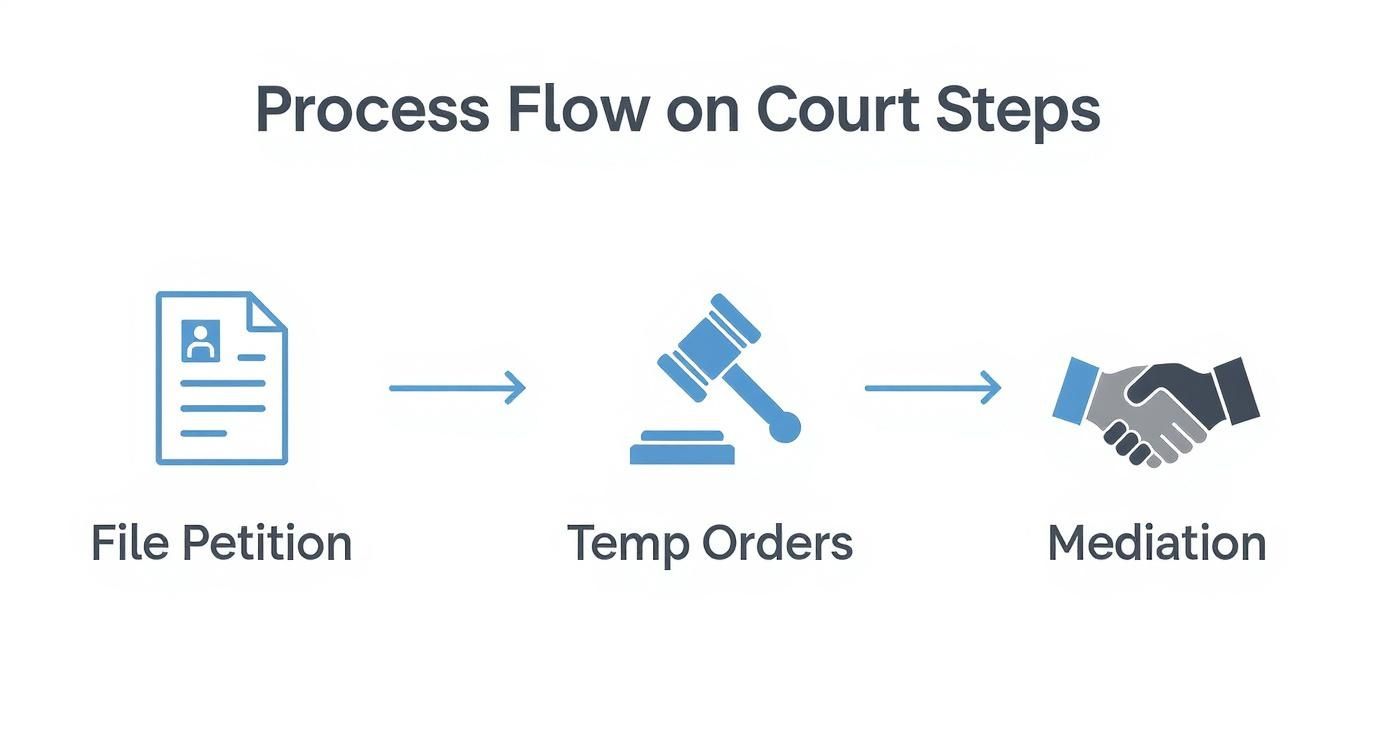
As you can see, Temporary Orders happen early. This is the first opportunity to establish financial support and clarify living arrangements while the rest of the case unfolds.
Child Support and Recent Changes to Texas Law
Child support is almost always a part of a custody order. The parent who doesn't have primary custody is typically ordered to make monthly payments. When a parent consistently fails to meet this obligation, judges take it very seriously. It can be a strong piece of evidence showing they aren't responsible enough for custody.
It's also crucial for parents in Northeast Houston to know about recent changes in the law. As of September 1, 2023, the income cap used to calculate child support in Texas went up from $9,200 to $11,700 in monthly net resources.
What does that mean in real dollars? For one child, the potential maximum support payment jumped from $1,840 to $2,340 per month. This change was made to better reflect the true cost of raising kids today. You can read more about these and other Texas family law changes on thetxattorneys.com.
A parent’s financial choices send a strong message to the court. Consistent failure to provide financially for a child can be interpreted as a failure to prioritize that child's well-being, which is a powerful argument in a sole custody case.
Knowing how to showcase your own financial stability—and expose the other parent's instability—is a strategic part of building a winning case. Finances are often tangled up with the other emotional aspects of a split, so a clear plan is essential. For those who are also navigating the end of a marriage, our team provides complete guidance on divorce proceedings in Humble.
If you’re worried about how financial issues might affect your fight for sole custody, we can help. Contact The Law Office of Bryan Fagan for a free, confidential consultation at our Humble office. We’ll sit down with you, listen to your story, and build a plan to protect your child’s future.
Common Questions About Sole Custody in Texas
When you're staring down a difficult custody battle, your mind is probably racing with questions. Here in our Humble office, we’ve heard just about everything. We want to give you clear, direct answers to the most common concerns we hear from families in Kingwood, Atascocita, and all over Northeast Houston, so you feel equipped to handle what comes next.
Can I Get Sole Custody Just Because We Don't Get Along?
In short, probably not. Texas courts start every single case with a presumption that joint custody is in the child’s best interest. The legal system is built on the idea that kids benefit from having both parents actively involved in their lives.
Because of this, simple disagreements, communication breakdowns, or not liking the other parent's new partner won’t be enough to strip away their parental rights. To win sole custody, you have to prove that the other parent's behavior or environment poses a genuine risk to your child's physical or emotional well-being. We're talking about serious issues like family violence, documented substance abuse, or severe neglect—and you’ll need solid evidence to back it up.
If I Win Sole Custody, Can the Other Parent Still See Our Child?
Yes, in almost every case. Securing sole custody, which is legally called a Sole Managing Conservatorship in Texas, means you have the exclusive right to make the big decisions for your child. It doesn't automatically erase the other parent from the picture.
The other parent is usually named the Possessory Conservator and is granted visitation rights, which are carefully detailed in a court-ordered possession order. If there are legitimate safety concerns, a judge can require these visits to be supervised by a professional agency or a trusted neutral person. Terminating a parent's right to see their child completely is incredibly rare and only happens in the most extreme cases of endangerment.
It's a huge misconception that "sole custody" means the other parent disappears. The court's primary goal is to protect the child, but it also wants to preserve the parent-child relationship whenever it's safe to do so. The fight is over decision-making authority and safety, not about eliminating a parent.
How Long Does a Sole Custody Case Take in Harris County?
This is a tough one because every case is different. If you and the other parent can somehow agree on all the terms, the case can be finalized fairly quickly. But if it's a contested case—meaning the other parent is fighting you every step of the way—you could be looking at a timeline of six months to well over a year before you get to a final trial. Harris County's family court system is one of the busiest in the entire state, which can add to the delays.
A good attorney will immediately file for Temporary Orders. This is a critical move that gets a temporary court order in place, establishing rules for who the child lives with, visitation schedules, and child support while the case is ongoing. It provides much-needed stability for your child right away.
My Child Is in an Unsafe Situation. What Is My Very First Step?
If your child is in immediate physical danger, stop everything and call 911. That is always your first move.
Your first legal step is to get in touch with a family law attorney who knows the Humble courts inside and out. They can move quickly to file for emergency relief from the court, like a Temporary Restraining Order (TRO), to put legal protections in place for your child immediately.
At the same time, start documenting everything. Create a log of dates, specific incidents, take screenshots of threatening text messages, save photos, and write down the names of anyone who witnessed what happened. Your attorney will use this evidence to build a strong argument for why the court needs to act now to protect your child.
When your child's future is at stake, you need a legal team that not only understands the law but also knows the local Harris County courts. At The Law Office of Bryan Fagan, we are committed to serving our Humble neighbors with strong, compassionate representation. We're here to answer your questions and fight for the best possible outcome for you and your child. To discuss your specific situation, contact us today for a free, no-obligation consultation by visiting our website at https://humbletxlawyers.com.