Life rarely stays the same, and what worked for your family a few years ago might not fit your reality today. For families here in Humble, Texas, a change in job status, a child's new needs, or other life events can make an old child support order feel unmanageable. When a court order that once seemed fair becomes a source of stress, it's important to know that the Texas legal system provides a way to adjust it. But you need to understand the rules of the road.
You can't just ask a court to change your child support because you feel like it. You have to prove there's been a "material and substantial change in circumstances" since the judge signed the last order. This is a legal standard that means something significant has happened—it’s not about minor, temporary fluctuations.
Knowing When It's Time to Modify Your Texas Child Support Order
For families across Humble, Atascocita, and Northeast Houston, life is always in motion. A new job, a layoff, a child's unexpected medical needs—these are the real-life events that can make an old child support amount completely unworkable.
The key is understanding what a Harris County court considers a legitimate reason to revisit the numbers. Simply agreeing with your ex-partner to change the payment amount isn't enough; you need a new court order to make it official and legally binding.
What Counts as a "Material and Substantial Change"?
This is the bedrock standard for any modification case. It has to be a real, meaningful shift that impacts either parent's ability to pay support or affects what the child needs financially. Think big, not small.
Here are a few common scenarios that courts in our area regularly see as valid grounds for a change:
- A Major Shift in Income: This is the most common reason. It could be an unexpected job loss, a significant promotion, or a career change that dramatically increases or decreases a parent's earnings.
- The Child's Needs Have Changed: Kids grow, and their needs evolve. A new medical diagnosis requiring expensive ongoing care, for example, is a classic reason for modification. The same goes for specialized tutoring or educational programs that weren't a factor before.
- The Custody Schedule Has Flipped: If the parent paying support (the obligor) suddenly has the child living with them far more often than the original order outlined, that's often a solid reason to adjust the support amount.
- A Parent Remarries: This one is a bit more nuanced. A new spouse's income isn't directly thrown into the child support calculation. However, it can change a parent's overall financial situation, freeing up their own income to better support their child, which a court can consider.
The "Three-Year, 20% or $100" Rule
Texas law also provides another, more straightforward path for a review. If it's been at least three years since your child support order was put in place or last modified, you can request a review.
Under this rule, a modification is often granted if the new, recalculated amount under Texas guidelines would be different from the current amount by either 20% or $100.
This rule is incredibly practical. It recognizes that even without one single dramatic event, incomes and the cost of living naturally drift over time. It gives parents in places like Kingwood and Humble a built-in opportunity to make sure their support order still makes sense.
Before you take action, it's helpful to see where your situation fits. This table breaks down the main eligibility criteria for a modification.
Quick Guide to Child Support Modification Eligibility
This table summarizes the primary reasons a Texas court, like those in Harris County, would consider a request to modify child support, helping Humble-area families quickly assess their situation.
| Reason for Modification | What It Means for You | Common Examples |
|---|---|---|
| Material & Substantial Change | A significant, ongoing life event has occurred since the last order was signed. | Involuntary job loss, major promotion, child diagnosed with a chronic illness, a parent becomes disabled. |
| Change in Child's Residence | The child's primary residence has changed from one parent to the other. | The child moves in with the parent who was previously paying support (the obligor). |
| Change in Possession Schedule | The amount of time the child spends with each parent has significantly changed. | A 50/50 possession schedule is adopted, or the non-primary parent now has the child much more often. |
| Three-Year Review | It's been 3+ years, and the guideline amount has changed significantly. | The calculated support amount is now at least $100 or 20% different from the current ordered amount. |
Understanding these criteria is the critical first step. You can learn more about how often child support can be modified in Texas.
If your circumstances seem to line up with one of these scenarios, it might be time to look at your legal options. At The Law Office of Bryan Fagan, we help families right here in our community figure out the best path forward. We offer a reassuring, confident call to action, encouraging you to schedule a free consultation with our Humble office.
Filing for a Child Support Modification in Harris County: A Step-by-Step Guide
So, you've looked at your situation and believe you have a solid reason to change your child support order. What now? If you're in Humble, Atascocita, Kingwood, or anywhere in Northeast Houston, your case will be handled by the Harris County court system. Taking that first step can feel intimidating, but knowing what to expect can make all the difference.
It all starts with one key legal document: the Petition to Modify the Parent-Child Relationship. This is the official paper you file with the court that kicks off the entire process, formally asking a judge to take a look at your existing support order.
Starting Your Case the Right Way
Think of this petition as the foundation for your entire case. It's not just a form to fill out. You’ll need to clearly identify the parents and children involved, reference the specific court order you want to change, and, most importantly, explain why you're asking for the modification. This is where you lay out the "material and substantial change" that has happened since the last order was signed.
Getting this document right is critical. Simple mistakes or unclear language can cause serious delays or even get your case thrown out before it really begins. You need to present your argument to the court clearly and legally from day one.
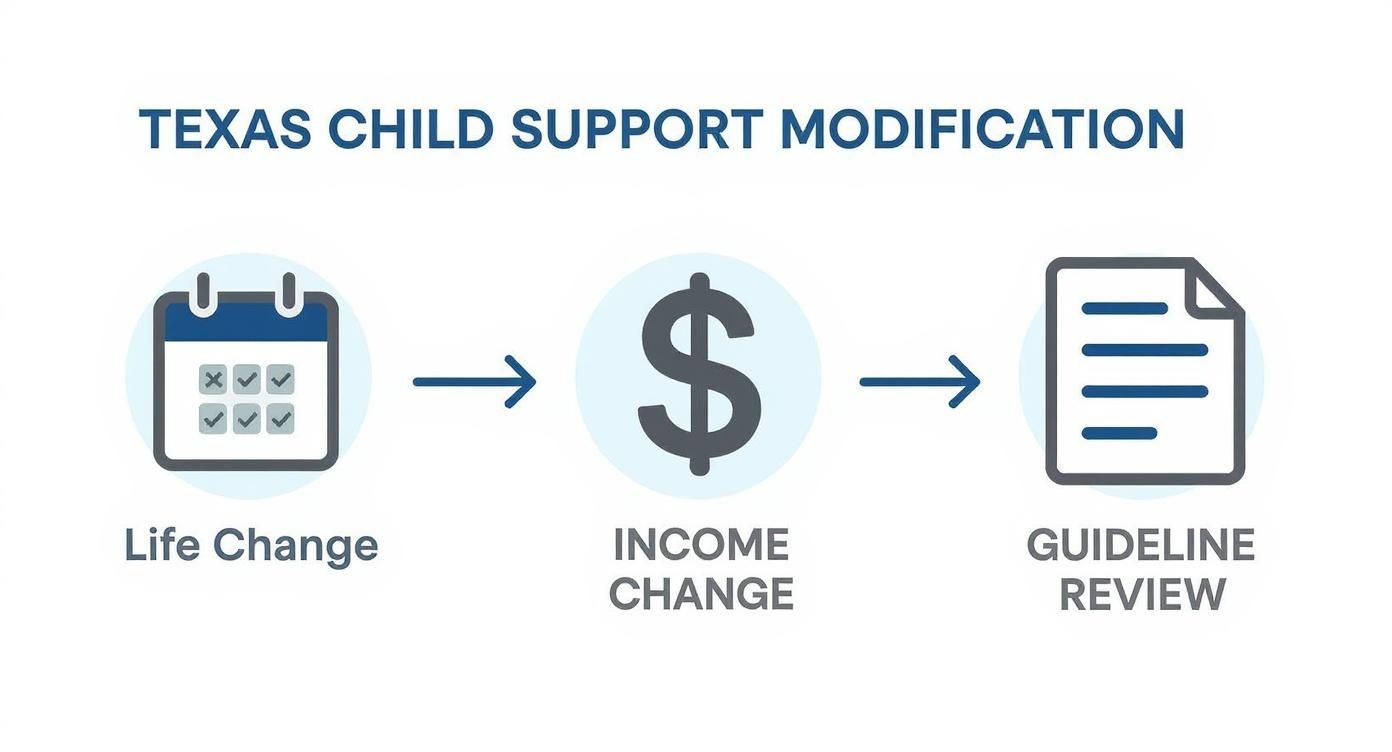
As you can see, the process is always triggered by a real-world event—a major life change, a shift in income, or simply hitting that three-year mark where a review is allowed.
Filing and Serving The Necessary Paperwork
Once your petition is ready, the next stop is the Harris County District Clerk's office at the downtown courthouse. You’ll file the petition and pay a filing fee, which usually runs a few hundred dollars. If that cost is a hardship, you can ask the judge to waive it by filing a form called a Statement of Inability to Afford Payment of Court Costs.
But filing the paperwork is only the first part. The other parent has to be officially notified that you've started a lawsuit against them. This legal notification is called service of process, and you can't just hand them the papers yourself.
You have a couple of options for formal service:
- Personal Service: You can pay a private process server or a local constable to track down the other parent and physically deliver a copy of the lawsuit along with a formal notice called a citation.
- Waiver of Service: If you're on good terms with the other parent, they can sign a Waiver of Service form. This is a signed, notarized document where they acknowledge they've received the lawsuit. It saves you the time, hassle, and cost of formal service.
Insider Tip: I tell every client this: make at least two copies of every single document you file. The original goes to the court clerk, one copy is for you, and the other is for the other parent. Staying organized is one of the easiest ways to keep your case from going off the rails.
Understanding the Initial Steps and Timelines
The moment the other parent is officially served, a legal clock starts ticking. They have a limited window of time to file a formal "Answer" with the court. In Texas, their deadline is the first Monday after 20 days have passed since they were served. Their Answer simply tells the court they are aware of the lawsuit and will be participating.
From there, the path your case takes depends entirely on how the other parent responds. If they don't file an Answer at all, you might be able to get a default judgment, but that's a tricky process. If they file an Answer and disagree with your request, the case becomes "contested," and you'll start moving toward exchanging financial information, mediation, and possibly a court hearing.
The truth is, navigating the filing rules, service deadlines, and specific procedures at the Harris County Civil Courthouse can be a minefield of small but critical details. One missed step can set your case back for months. This is often the point where local Humble residents realize that having an experienced local attorney is less of a luxury and more of a necessity.
At The Law Office of Bryan Fagan, our team is in the Harris County courthouse every day, handling these exact filings for families in our Humble community. We know the local rules inside and out and can make sure your case starts off on the right foot. If you're ready to get started, we invite you to schedule a free consultation at our Humble office to talk about your specific situation and get some clear, honest advice.
Building a Strong Case with the Right Evidence
When it comes to modifying a child support order in Texas, you can't just walk into a courtroom and tell your story. A Harris County judge needs to see cold, hard proof. They operate on evidence, not just your word, that a "material and substantial change" has occurred in your circumstances.
For families here in Humble and Kingwood, this means you have to translate your life changes into a language the court understands: documentation. Your story is the framework, but the documents are what make your case solid.

Gathering Proof of an Income Change
This is usually the most common reason for a modification, whether you're asking for more support or looking to pay less.
- If You Lost Your Job: This is pretty clear-cut. The most powerful piece of paper you can have is your termination letter. You'll also want to bring in your last few pay stubs to show what you were making, plus proof from the Texas Workforce Commission that you're actively seeking unemployment benefits.
- If Your Income Went Down: Maybe you had to take a lower-paying job. You’ll need pay stubs from both your old job and the new one to show the difference. It's also a smart move to keep a log of your job search. This shows the judge you're making a good-faith effort to find comparable work and not just trying to duck your support obligation.
- If the Other Parent Got a Big Raise: This can be a bit trickier, since you don't have direct access to their financials. If you have a strong reason to believe their income has jumped, your attorney can use legal tools, like a Request for Production of Documents, to get ahold of their recent pay stubs and tax returns.
Documenting Changes in the Child’s Needs
Has your child’s financial needs grown significantly? You have to back this up with specifics. Simply telling the judge that things are "more expensive" won't cut it.
For instance, if your child living in Atascocita now needs special tutoring, you need to provide the actual invoices from the tutoring center. Show the canceled checks or bank statements that prove you're the one paying those bills. The same principle applies to any new medical needs.
What Strong Evidence Looks Like:
- A letter or report from a doctor outlining a new diagnosis.
- Pharmacy receipts for new, ongoing prescriptions.
- Invoices and payment records for things like physical therapy or specialized medical equipment.
- Enrollment forms and tuition receipts for necessary educational support.
Financial records are absolutely essential here. If you need a hand getting your bank documents in order, there are some great online guides for accessing and managing your online bank statements that can help.
As a local attorney who cares about our community, I can tell you from years of experience in Harris County family courts: organization is everything. A judge is far more likely to be persuaded by a neatly organized binder of documents than by someone fumbling through a messy stack of papers. It shows you're serious and prepared.
Your Credibility is on the Line
Ultimately, a modification case often comes down to two things: the quality of your evidence and your credibility. The court is always going to put the child’s best interests first, and your evidence needs to speak to that.
Simply stating you can no longer afford the payments is never enough. You have to show the judge that your financial change is significant, involuntary, and directly impacts your ability to meet the current order without causing undue hardship.
The work you put into gathering and presenting this evidence is very similar to preparing for a custody case. For more on that, you can check out our guide on how to prepare for a custody hearing in Texas.
Building a persuasive case is a detailed and often overwhelming process. At The Law Office of Bryan Fagan, we work with our Northeast Houston neighbors every day to assemble the right documentation to tell a compelling, fact-based story to the court. If you're not sure where to even begin, schedule a free consultation with our Humble team so we can review your situation.
Choosing Between Mediation and a Contested Hearing
https://www.youtube.com/embed/iZFoz0WOqPw
So, you’ve filed your Petition to Modify. What happens now? Your case is about to head down one of two very different paths. For many families in Humble and Atascocita, the next step involves sitting across a table from the other parent to find some common ground. For others, it’s about gearing up for a formal courtroom battle.
Knowing the difference between mediation and a contested hearing is absolutely crucial for managing your expectations and preparing for what's ahead.
Before a Harris County family court judge will even think about scheduling a final hearing, they'll almost certainly order you and the other parent to try mediation first. There's a simple reason for this: mediation often works. It’s a process designed to put the decision-making power back into your hands, not a judge's.
The Power of Mediation
Mediation is a confidential meeting where you, the other parent, and your lawyers sit down with a neutral third party, known as the mediator. The mediator isn't there to pick sides or issue a ruling. Their entire job is to guide the conversation and help you both find a middle ground you can live with.
The single biggest advantage of mediation is control. Think about it: in a courtroom, a judge who has only known your family for a few hours will make a binding decision based on a quick snapshot of your lives. But in mediation, you're in the driver's seat. You have the power to create a solution that actually fits your family’s unique situation, your work schedules, and what your child truly needs.
From my experience helping local families, here are the core benefits of settling your case in mediation:
- It’s Cheaper: A contested hearing can get expensive, fast. You’re paying for multiple days of an attorney's prep time and their time in court. Mediation is usually a half-day or full-day event, which saves a significant amount of money.
- It’s Quicker: Trying to get a final hearing date on a crowded Harris County court docket can take months. A successful mediation can wrap up your entire case in a single afternoon.
- It’s More Amicable: The whole process is built on collaboration, not conflict. It forces communication and helps you maintain a working co-parenting relationship, which is priceless for your child's well-being.
Once you sign a Mediated Settlement Agreement (MSA), it becomes a legally binding contract. It's incredibly difficult for either person to back out, which gives you finality and peace of mind. The judge will then sign an official order that matches the terms you both agreed to.
When a Court Hearing Becomes Necessary
But what if you just can't find that common ground? If you and the other parent are worlds apart on the key issues, and mediation doesn't produce an agreement, your case will be scheduled for a contested final hearing.
This is the scenario you see on TV. You and your attorney will present your evidence and arguments to the judge, who listens to both sides and then makes a final, binding decision.
A contested hearing is a formal, adversarial process. The rules of evidence are strictly enforced. Each side gets to call witnesses, cross-examine the other parent, and submit documents for the judge to review. All that evidence you carefully collected—pay stubs, medical bills, emails—suddenly becomes the most important part of your case.
This is where your preparation really pays off. The judge will be looking directly at your documents to decide if a "material and substantial change" has actually happened and what the new child support amount should be. Navigating this high-stakes environment without experienced legal guidance is something I never recommend. To get a better sense of what to look for in representation, read our guide on how to choose a family law attorney.
Whether you're heading for a mediation table or a courtroom, you don't have to figure it all out on your own. At the Law Office of Bryan Fagan, we're dedicated to helping our neighbors in Kingwood and Northeast Houston get through these tough situations. We can help you prepare to negotiate effectively in mediation or build a strong, evidence-based case for a hearing. We offer a reassuring, confident call to action: schedule a free consultation with our Humble office to talk about the best path forward for your family.
How Texas Child Support Calculations Work

If you're going to successfully argue for a child support modification, you have to speak the court's language—and that language is all about the math. A Harris County judge doesn't just pull a number out of thin air. They are required to follow a specific formula laid out in the Texas Family Code, and understanding this formula is the key to building a strong case.
The entire system is built around a parent's net monthly resources. This isn't just what’s on a paycheck; it's the sum of nearly all money you receive, from almost any source.
Calculating Net Monthly Resources
Before any percentages come into play, the court has to figure out the paying parent's total income. This goes way beyond a base salary.
Common sources of income include:
- Wages, salary, commissions, and overtime
- Self-employment income and business profits
- Rental income from properties
- Retirement benefits, pensions, and annuities
- Social Security or disability benefits (with some exceptions)
From this gross figure, the court subtracts only a few specific, allowable deductions to get to your net monthly resources. These are limited to things like federal income taxes (calculated for a single person with one exemption), Social Security and Medicare taxes, union dues, and the actual cost of the child's health and dental insurance. Things like car payments, credit card bills, or rent are not part of this calculation.
The Guideline Percentage System
Once that net resource number is locked in, the court applies a standard percentage. This percentage is based on how many children are included in the support order. For families in Humble, Kingwood, and across Texas, these guidelines are the starting point for almost every child support calculation.
The whole point of the guideline system is to create consistency and predictability. It ensures children receive a similar level of financial support, no matter which courtroom their parents find themselves in.
This quick reference table shows the standard percentages a judge will use as their baseline.
Texas Standard Child Support Guideline Percentages
This table breaks down the percentage of net monthly resources applied based on the number of children before the court.
| Number of Children | Percentage of Net Resources |
|---|---|
| 1 Child | 20% |
| 2 Children | 25% |
| 3 Children | 30% |
| 4 Children | 35% |
| 5 Children | 40% |
| 6+ Children | At least 40% |
As you can see, the math is straightforward. So, if a parent in Atascocita has net monthly resources of $5,000 and two children, the guideline child support amount would be $1,250 per month (25% of $5,000).
The Income Cap and Its Impact
There's one more major piece to this puzzle: the "cap." Texas law sets a maximum amount of net resources to be used in the calculation, which is meant to keep support amounts reasonable, even for very high earners. The state adjusts this cap every few years to keep up with economic changes.
For instance, Texas recently increased the income cap, a statutory update that happens every six years. This directly impacts higher-income parents by raising the ceiling on income subject to the guideline percentages. If a parent earns more than the cap, their child support is usually calculated based on the capped amount, though a judge has the discretion to order more if the child's proven needs justify it. You can discover more insights about these economic adjustments and see how they might affect your specific situation.
Getting a handle on these numbers is fundamental when you want to modify child support in Texas. It allows you to anticipate what a judge is likely to order and helps you build a case based on the exact same rules the court follows.
If you're staring at your pay stubs and financial statements trying to make sense of it all, don't guess. At The Law Office of Bryan Fagan, we can walk you through the math and explain your options clearly. We invite our Northeast Houston neighbors to schedule a free consultation at our Humble office to get the clarity you need.
Common Questions About Modifying Child Support in Texas
When you start looking into changing a child support order in Texas, it’s natural to have a lot of questions. Here in our Humble office, we talk to families from Kingwood, Atascocita, and all over the area who often share the same concerns. Let's walk through some of the most common questions we hear, so you can get a clearer picture of the road ahead.
Every family's story is different, but getting a handle on these basics can help you sidestep common mistakes and move forward with confidence.
Can We Just Agree to Change Support Without Involving a Judge?
It’s an appealing thought, isn't it? You and the other parent are getting along, you both agree a new amount makes sense, and you decide to seal it with a handshake. While it feels simple and efficient, handling it this way is a huge legal risk for everyone involved.
Here’s the hard truth: in Texas, a verbal agreement or even an informal written note is not legally enforceable. The only document that matters is the official court order signed by a judge. If the parent receiving support later claims you haven't paid enough, the court will only look at that original order. Any payments you missed based on your informal "agreement" will be treated as unpaid child support, which can land you in serious trouble.
Let me be crystal clear: until a judge signs a new order, the old one is still in full force. You absolutely must go through the court to formalize any changes. It's the only way to protect yourself and make sure the new amount is legally binding.
How Long Does a Modification Take in Harris County?
This is probably the most practical question we get, and the honest answer is: it really depends. The timeline for a child support modification in the Harris County court system can be quick or it can be a marathon.
- If You Both Agree: When you and the other parent see eye-to-eye on all the details, the process is much faster. After filing the necessary paperwork, you could have a final, signed order from a judge in just a few months.
- If You Disagree: This is where things slow down significantly. A contested modification means you'll probably have to go to mediation, and if that doesn't work, a final hearing in front of the judge. With the crowded court dockets in Harris County, a contested case can easily take six months to over a year to be fully resolved.
What if My Ex Quits Their Job to Avoid Paying?
It’s a deeply frustrating situation, and sadly, one we see all the time here in the Humble area. A parent suddenly leaves a high-paying job or takes a massive pay cut right when a modification case is on the table. Courts see this happen, too, and they are often highly skeptical. This is known as intentional unemployment or underemployment.
Texas judges have the power to look beyond a person's current paycheck. If a judge believes a parent is deliberately earning less just to shrink their child support obligation, they can calculate support based on that parent’s earning potential. This means they'll base the order on what that parent should be making, considering their skills, education, work history, and the job market. This is done to ensure the child’s needs are still met.
Can I Stop Paying Support If I’m Not Allowed to See My Kids?
This is one of the most important things to understand about Texas family law: child support and visitation are two completely separate legal duties. You cannot use one as a bargaining chip for the other.
Withholding child support payments because you're being denied access to your child is a direct violation of a court order. It can trigger severe enforcement actions against you, including wage garnishment, driver's license suspension, and even jail time. On the flip side, the other parent can't legally deny your court-ordered visitation just because you're behind on payments. You can learn more about the serious consequences of back pay child support in Texas. The correct move is to file a separate enforcement action with the court to protect your visitation rights.
Trying to answer these complex questions on your own can be overwhelming. At The Law Office of Bryan Fagan, we pride ourselves on giving practical, clear-headed legal guidance to our neighbors in the Humble community. If you're dealing with a child support issue, we offer a reassuring, confident call to action. Reach out to us to schedule a free consultation with our Humble office today.