When you're creating a parenting plan in Texas, you're essentially laying out the ground rules for your co-parenting relationship. For families here in Humble, this document covers everything from custody (what Texas law calls conservatorship) and visitation schedules to how you'll make big decisions about your child's health, education, and general well-being. The goal is to create a clear, comprehensive guide that puts your child's best interests first, which you'll then file with the local Harris County court to make it official.
Building a Roadmap for Your New Family Structure
Going through a separation or divorce here in Humble is never easy, but drafting a parenting plan doesn't have to be another source of stress. It's better to think of it as a roadmap for your family's new reality. It's a tool meant to create stability for your kids and cut down on future arguments between you and your co-parent. As an attorney who works with families in our community every day, I can tell you that a thoughtfully written plan is one of the most powerful things you can have to navigate the road ahead.
This isn't just friendly advice—it's what the local courts want to see. Judges in Harris County really appreciate detailed, realistic parenting plans. Why? Because it shows them that both parents are committed to working together and are putting their kids first. Taking this proactive step sends a strong message to the court that your children's well-being is your top priority.
Why a Written Plan Is So Important for Humble Families
A verbal agreement might seem fine when you're on good terms, but life has a way of throwing curveballs. A new job opportunity in Northeast Houston, a sudden change in school schedules, or even a new partner can create friction you didn't see coming. Having a formal, written plan gives you a legally enforceable framework to rely on, which is crucial for maintaining consistency for your children.
The real purpose of a parenting plan is to keep your kids out of the middle of parental conflict. When you agree on the rules ahead of time, you build a predictable and secure world where they can still thrive, even as your family changes.
The good news? You don't have to figure this out by yourself, and a drawn-out court battle isn't a foregone conclusion. The vast majority of families in Humble, Atascocita, and Kingwood are able to create these plans together, usually with guidance from their attorneys or a mediator. Starting off with that kind of cooperation really sets a positive tone for the co-parenting years to come.
To give you some perspective, nationwide about 90% of custody arrangements are settled outside of a courtroom. Parents work out an agreement and simply put it in writing. This fits with a larger trend, where roughly 81.6% of divorces in 2023 were resolved by mutual agreement. These numbers show why courts are so supportive of collaborative solutions. If you're interested, you can read more about the latest family law statistics to see these trends for yourself.
Before we dive into the specifics, it's helpful to see the core pieces of a parenting plan all in one place. This will give you a clear picture of what you and your co-parent will need to discuss and decide on.
Key Components of a Texas Parenting Plan at a Glance
| Component | Why It's Essential for Your Humble Family |
|---|---|
| Conservatorship | Designates who has the legal right to make major decisions for your child. |
| Possession Schedule | Creates a clear calendar for when the child lives with each parent, avoiding confusion. |
| Child Support | Ensures the child's financial needs are met consistently by both parents. |
| Healthcare Decisions | Outlines who makes medical choices and who covers health/dental insurance. |
| Educational Decisions | Determines who has the right to make choices about school and extracurriculars. |
| Communication Rules | Sets expectations for how you and your co-parent will communicate about the kids. |
| Dispute Resolution | Provides a process for resolving disagreements without immediately going to court. |
This table covers the fundamentals, but a strong plan will also get into the finer details. Thinking through these elements now prevents headaches and conflict later on.
Crafting a parenting plan is your chance to take charge of your family’s future. It empowers you and your co-parent—not a judge—to make the most important decisions affecting your children's lives. If you need help writing a plan that truly protects your family, our team at The Law Office of Bryan Fagan is here to guide you. Schedule a free consultation with our Humble office today to start building your family's roadmap.
Defining Roles and Routines in Your Plan
Once you have the big picture sorted out, it's time to roll up our sleeves and get into the nuts and bolts of your parenting plan. This is where we translate those big legal concepts into the day-to-day reality for your family. We’re talking about defining who does what and creating routines that give your kids the stability they need to thrive.
Getting these roles and routines down on paper isn't just a legal formality; it's a huge part of creating a predictable new normal for your children. In fact, a clear structure has a profound effect on the impact of parent-child relationships on mental health.
The two main pillars we'll build are conservatorship (who makes the decisions) and the possession schedule (who has the kids, and when). Let's break down what these terms really mean for families here in Humble, Atascocita, and Kingwood.
Understanding Conservatorship in Texas
First things first: in Texas, we don't really say "custody." The legal term is conservatorship, and it's all about a parent's legal rights and responsibilities. Think of it less as where your child sleeps at night and more about who has the final say on the big-ticket items in their life.
As a local attorney advising Humble families, I can tell you that Texas courts typically lean toward one of two arrangements:
- Joint Managing Conservatorship (JMC): This is by far the most common setup in Harris County. It’s what courts presume is in a child's best interest. With a JMC, both parents share the rights and duties of raising their children. One parent, however, is usually named the "primary" conservator. This just means they have the exclusive right to decide where the kids live, typically within a certain area like Humble ISD or a part of Northeast Houston.
- Sole Managing Conservatorship (SMC): This is much less common and is usually reserved for tough situations. A judge might order an SMC if one parent has a history of family violence, struggles with substance abuse, or if the conflict between parents is so high that making decisions together would actually harm the child. The Sole Managing Conservator gets to make most of the major life decisions alone.
Choosing the right path really hinges on your family's specific circumstances. To get a better feel for how these play out in the real world, check out our deep dive into joint custody vs. sole custody in Texas.
This decision tree gives you a visual of the paths you might take. If you can agree, you move straight to drafting a plan. If not, mediation or even court might be necessary.
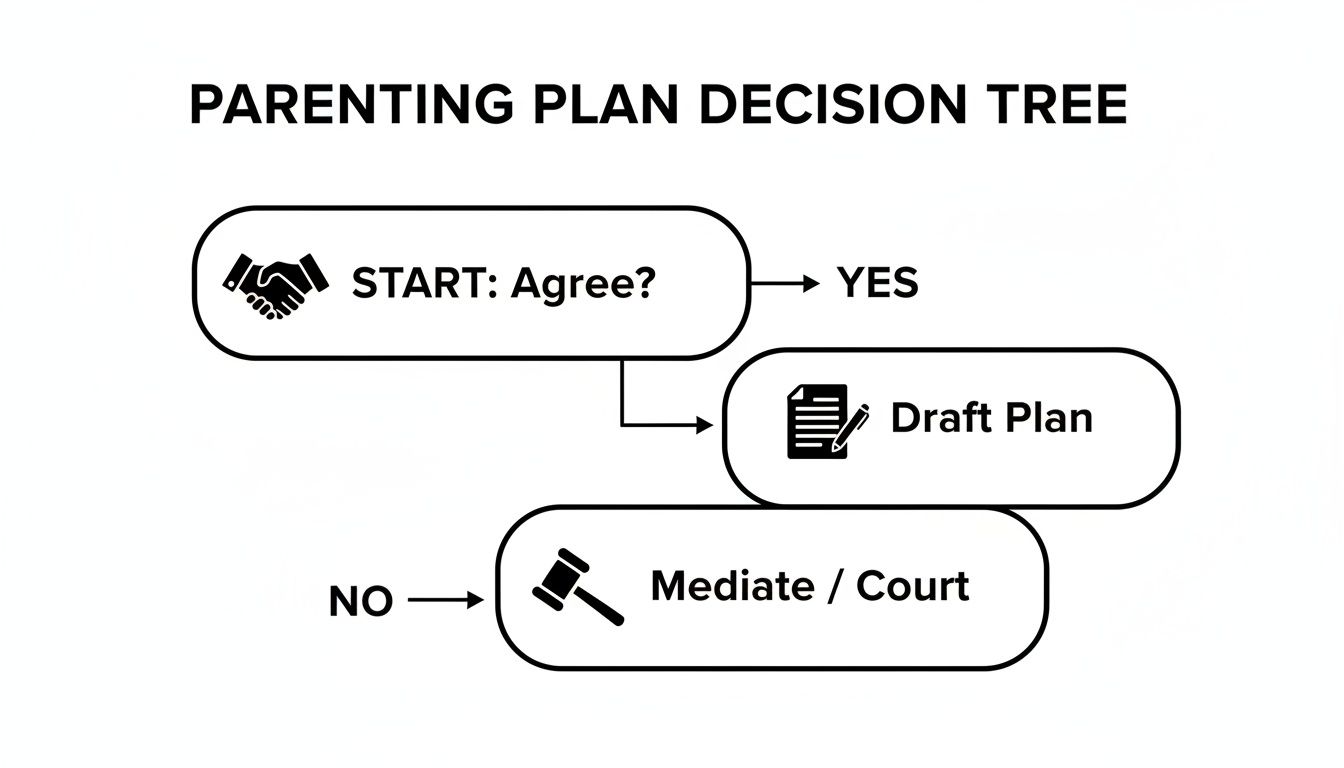
The takeaway here is pretty clear: starting from a place of agreement is always the smoothest road for Humble families.
Crafting a Possession and Access Schedule
Now for the "possession schedule"—that’s lawyer-speak for the calendar that maps out when your child is with each parent. This is the part of your plan that builds routine and consistency, which kids desperately need. While you have the freedom to create a fully custom schedule, most Texas families use the Standard Possession Order (SPO) as their starting point.
The SPO is a default schedule designed by the Texas Legislature to be predictable and straightforward. How it works depends on how close the parents live to each other.
- Parents Living Under 100 Miles Apart: If you and your co-parent are both in the Northeast Houston area—say, one in Humble and the other in Kingwood—the non-primary parent usually has the kids on the first, third, and fifth weekends of the month.
- Parents Living Over 100 Miles Apart: When there's significant distance, the schedule naturally has to adapt. The non-primary parent might get the kids for the entire spring break and a longer, solid block of time during the summer to make up for the lack of frequent weekend visits.
The Standard Possession Order is a great starting point, but it's not a one-size-fits-all solution. Your family's unique needs, work schedules, and traditions should shape the final schedule. Customization is key to making a plan that actually works for you.
Customizing Your Holiday and Summer Schedules
The SPO covers holidays and summer vacation, but honestly, this is where most of the customization happens—and for good reason. You and your co-parent absolutely should tailor these parts of the schedule to fit your family’s traditions.
Here are a few common ways families make it their own:
- Alternating Major Holidays: Lots of families agree to alternate big holidays like Thanksgiving and Christmas. For instance, the kids might spend Thanksgiving with Mom in even-numbered years and Dad in odd-numbered years, then flip that for Christmas.
- Splitting the Holiday: You could also split the day itself. I've seen plans where one parent has the kids on Christmas Eve and the other gets Christmas Day.
- Writing in Your Own Traditions: Your plan can protect special days unique to your family. Think about specific religious holidays, annual family reunion weekends, or even just making sure each parent gets time with the child on their own birthday.
By carefully defining these roles and routines, you’re doing more than just filling out a legal document. You're building a stable foundation for your children's future and creating a new normal that feels secure. If you’re feeling a bit lost in all these details, please know you don’t have to do it alone. The Law Office of Bryan Fagan is here to help you navigate this. We are your local Humble attorneys, committed to our community. Schedule a free, no-obligation consultation at our Humble office and let's talk about crafting a parenting plan that protects what matters most.
Going Beyond the Basics: Details That Prevent Future Fights
Once you’ve hammered out the main possession schedule and who has the right to make major decisions (conservatorship), you might feel like you’re done. But from my experience helping families across Humble, Atascocita, and Northeast Houston, I can tell you that the real work—the work that saves you future headaches—is in the details.
A truly effective parenting plan anticipates the small, everyday friction points that can easily blow up into major arguments. Think of it as creating a clear rulebook for your co-parenting relationship. It’s not about being controlling; it's about protecting your kids from getting caught in the middle of unnecessary conflict.

Establishing Clear Medical and Educational Guidelines
Two of the biggest battlegrounds for co-parents are healthcare and school. Your parenting plan is the perfect place to short-circuit these disputes before they even start by spelling out exactly how these decisions will be handled.
Take school, for instance. Who gets to decide which school the child attends? If you both live in Humble ISD, this might seem simple. But what happens if one of you moves to a neighboring district next year? Your plan needs to designate which parent has the exclusive right to establish the child's primary residence for school enrollment purposes. This one clause can prevent a massive legal fight down the road.
Healthcare is another area filled with potential landmines. While Texas law is clear that either parent can consent to emergency medical care, what about all the non-emergency situations?
- Routine Care: Who's in charge of scheduling the annual check-ups and dental cleanings? Can one parent take the child to the doctor without getting the other's explicit permission first?
- Major Procedures: How will you decide on bigger things, like getting braces or having elective surgery? Do you need mutual agreement, or will one parent have the final say after a good-faith discussion?
- Mental Health: What happens if a school counselor recommends therapy for your child? Will you both agree to it? How will you choose the right professional?
A well-drafted clause can solve this: "Both parents shall have full access to all medical and educational records. For non-emergency medical decisions, the parents will consult with one another. If an agreement cannot be reached within 7 days, Parent A shall have the right to make the final decision."
Having a clear process like this means you're not trying to figure things out in the middle of a stressful medical situation.
Setting Rules for Communication and New Relationships
Healthy communication is the fuel that makes a co-parenting relationship work. Your plan should set reasonable, practical expectations for how you'll talk to each other and how you'll each stay in touch with the kids when they're at the other parent's home.
For parent-to-parent communication, decide what works best. Many of our local clients find that using a dedicated co-parenting app or sticking to email for non-urgent matters keeps conversations focused and business-like. Urgent issues, of course, might require a phone call or text.
For staying in touch with the children, get specific:
- Set reasonable times for phone or video calls (e.g., "daily between 6:00 PM and 8:00 PM").
- Include a sentence that says neither parent will interfere with or monitor the other's scheduled communication time.
Another area that’s surprisingly ripe for conflict is introducing new partners. You can protect your children by agreeing on some ground rules ahead of time. A common and very helpful clause might state that neither parent will introduce a new significant other to the children until the relationship has been established for a specific period, like six months, and only after notifying the other parent first. This simple rule prevents a revolving door of new faces and gives your kids time to adjust.
Managing the Logistics of Transportation and Activities
For families spread out across Kingwood, Atascocita, and Humble, the simple act of getting kids from one house to another can become a major source of tension. Your parenting plan needs to be crystal clear about transportation to make exchanges as smooth and painless as possible.
Think through these practical points:
- Who drives? Will one parent always handle drop-offs, or will you meet in the middle? A neutral public spot, like a library parking lot, can sometimes lower the tension.
- What if someone is late? A simple rule like, "Each parent must provide at least 30 minutes' notice if they anticipate being late for an exchange," can prevent a lot of frustration and angry texts.
- How do you handle extracurriculars? Define who is responsible for getting the kids to and from practices, games, and lessons. Just as importantly, decide how you'll split the costs for fees, uniforms, and equipment, as these are almost never covered by standard child support.
By tackling these details in your parenting plan now, you're not just filling out a legal document. You are building a stable, low-conflict framework that allows your children to thrive.
If you’re wrestling with how to get all these crucial details into your plan, you don't have to guess. Our experienced family law attorneys at the Law Office of Bryan Fagan can help you craft a plan that truly fits your family's needs. Schedule a free, no-obligation consultation at our Humble office to get started.
Weaving Financial Stability Into Your Parenting Plan
A parenting plan does a lot more than just lay out schedules and who makes what decision. Think of it as a financial blueprint for your children's future. Let's be honest: money is a massive source of conflict for couples, and when you're co-parenting, that stress can easily bleed over and impact your kids. By getting the financial details down in writing, you’re not just creating rules; you're creating predictability and security for everyone.
For families here in Humble, Atascocita, and the rest of Northeast Houston, this means going beyond a simple handshake agreement. I've seen it time and again in my practice—informal arrangements fall apart, leaving one parent carrying an unfair burden and, worse, creating instability for the children. A court-approved plan makes it crystal clear who is responsible for what.
The Cornerstone: Child Support in Texas
The foundation of any solid financial plan for co-parenting is child support. Fortunately, in Texas, we don't have to guess. The law gives us a clear, guideline-based formula to figure out payments. This takes a lot of the emotion and guesswork out of a very sensitive topic. The calculation hinges on the non-primary parent's net monthly income and how many children they are supporting.
Putting a formal child support order in your plan is non-negotiable if you want to protect your kids. The national data backs this up. In 2021, over 4 million parents in the U.S. were receiving child support. But as of 2018, a staggering 7.1 million custodial parents had no legal agreement in place at all. That gap is where the problems start. For Humble families, this really drives home why you need specific terms—who pays, how much, and when—locked into your court order.
It's so important to remember that child support isn't a payment to the other parent. It's an investment in your child's well-being. Formalizing it ensures their needs are met consistently, no matter how your relationship with the other parent evolves.
Looking Beyond the Basics: Handling Extra Expenses
Standard child support is designed to cover the essentials: a roof over their head, food on the table, and clothes on their back. But as any parent in our community knows, the costs of raising a child go way beyond that. A truly effective parenting plan tackles these additional expenses head-on to prevent arguments down the road.
Your plan needs to spell out responsibility for things like:
- Health Insurance: Which parent is going to carry the kids on their health and dental plan?
- Uninsured Medical Costs: How are you splitting co-pays, prescriptions, braces, and anything else insurance doesn't cover? A 50/50 split is common, but this can be adjusted based on each parent's income.
- School and Extracurriculars: Who covers school supplies, field trip fees, sports uniforms, music lessons, or summer camp? Be specific. It prevents that moment of panic when a registration form comes home.
It's also smart to think about the bigger financial picture. Your plan can require each parent to maintain a life insurance policy that names the children as beneficiaries. You should also decide who will claim the children as dependents on their taxes each year—often, parents agree to alternate years. For some great guidance on teaching your kids good money habits, check out this complete guide to financial literacy for kids.
Life happens, and financial situations can change. If a parent gets a big promotion or loses their job, you might need to update the support order. You can learn about that process in our guide on how to modify child support in Texas.
Building a strong financial section in your parenting plan provides a solid foundation for your children's security. If you need a hand making sure every detail is covered, our team at The Law Office of Bryan Fagan is here to help our neighbors. Schedule a free consultation with our Humble office to talk about how we can protect your family’s financial future.
Making Your Plan Work for Real Life in Humble
A parenting plan that looks great on paper but falls apart in practice isn't worth much. The real test is whether it can handle the day-to-day realities of your family's life right here in Humble or Atascocita. We’re talking about your work schedule, your kid's school, and the simple, everyday logistics of co-parenting in Northeast Houston.
This is where the legal jargon gets a dose of reality. We need to turn a court document into a practical, workable guide for your new family dynamic. The focus has to be on what’s genuinely best for your child, creating a plan that's solid but also flexible enough to bend when life inevitably throws you a curveball.

Locking in Consistent Communication and Contact
One of the most vital roles of a realistic plan is to protect the bond between parent and child, especially for the non-custodial parent. Simply setting a possession schedule isn't enough; you have to intentionally build in consistent, reliable communication.
This isn't just a "nice-to-have"—the national statistics are sobering. In the U.S., about 80% of the 12.9 million custodial parents are mothers. What’s more, nearly 60% of non-custodial fathers connect with their children just four times a month or less. When we help Humble parents build regular contact into their plan, we are proactively fighting against a pattern that can damage a child’s well-being. You can discover more insights about child custody statistics to see just how critical this is.
Your plan should get specific about:
- Scheduled Video Calls: Pinpoint exact days and times for FaceTime or other video chats. Seeing a parent's face is incredibly reassuring for kids of all ages.
- Phone Calls: Set a predictable window for daily or every-other-day phone calls so your child knows when to expect that call.
- Clear Rules: The plan must state that neither parent can unreasonably interfere with this scheduled communication.
Building a Plan Around Your Child's Age and Needs
A plan for a toddler in daycare is going to look completely different from one for a teenager at Atascocita High School. A practical plan has to be age-appropriate from day one, with an eye toward how it will evolve as your child grows.
For young children (ages 0-5), the name of the game is stability and frequent contact with both parents. Shorter, more frequent visits often work far better than long weekends away from their primary home.
Once they're school-aged (ages 6-12), the school calendar becomes the framework for everything. You have to consider:
- School Location: Pickups and drop-offs need to make sense. If one parent lives in Kingwood and the other is still in Humble, who’s responsible for getting them to soccer practice?
- Homework Routine: How will you work together to make sure homework and school projects are completed on time, no matter whose house it is?
For teenagers (ages 13-18), flexibility is everything. Their social lives, part-time jobs, and extracurriculars demand a more adaptable schedule. A great plan for a teen often gives them more input and builds in a way for parents to agree to last-minute changes.
The most successful parenting plans are living documents. They are designed not just for the family you are today, but with an eye toward the family you will be in two, five, and ten years. Building in a process for reviewing the plan annually is a smart, proactive step.
Crafting a plan that is both legally sound and truly practical for your Humble family is a balancing act. You don't have to figure it out alone. Schedule a free consultation with our Humble office, and let's work together to create a plan that genuinely serves your children's best interests.
Finalizing Your Plan with the Harris County Court
You’ve done the hard work. You've negotiated, compromised, and built a parenting plan designed to protect your children and provide stability. Now it's time to make it legally binding. For families in Humble, this means taking the final step through the local Harris County court system.
Once you and your co-parent have signed the parenting plan, it doesn't just sit in a drawer. It's formally submitted to a judge as part of your final divorce decree or custody order. The judge's job is to review the plan and confirm that everything in it serves your child’s best interests. After a thorough review, the judge signs it, and just like that, your document transforms into an enforceable court order.
The Power of Mediation
But what if you're almost there? Maybe you've agreed on 90% of the plan but are deadlocked on a few stubborn issues. This is precisely where mediation can save the day.
Mediation is a structured, confidential process where you and your co-parent sit down with a neutral third-party mediator. Their role isn't to take sides but to help you find common ground and negotiate those last few details. For many families in Kingwood and Atascocita, it's a far less stressful and significantly less expensive alternative to a courtroom battle. More importantly, it keeps you in control of the outcome.
A court order provides the ultimate safety net. It ensures that the rules you’ve carefully created for your children’s well-being are not just suggestions but legal requirements that can be enforced if one parent fails to comply.
When Life Changes: Modification and Enforcement
Life doesn't stand still, and your parenting plan needs to be able to adapt. A new job offer in Northeast Houston might require a move, or as your children grow, their needs will certainly evolve. You can legally change your court-ordered plan through a process called modification. To do this, you'll need to prove to the court that there has been a "material and substantial change" in your family's circumstances.
On the other hand, what if your co-parent simply isn't following the rules? Maybe they are consistently late for exchanges, miss their scheduled time, or refuse to pay their share of medical bills. You have recourse. This is called enforcement, and it involves asking the court to step in and compel the other parent to comply with the order. It's critical to know these options exist before you ever need them. For more complex situations, you can get insights on how to prepare for a custody hearing.
This final stage is about building a legal foundation for your family's future. Don't leave it to chance. At The Law Office of Bryan Fagan, we make sure your plan is solid, enforceable, and ready for the scrutiny of the Harris County court. We are a local firm that cares about our community. Schedule a free consultation with our Humble office today to protect what matters most.
Got Questions? We've Got Answers About Texas Parenting Plans
Even with the best guide in hand, I know questions always come up when you start putting pen to paper on a parenting plan. Here are some of the most common ones we hear from our clients right here in Humble, Kingwood, and Atascocita.
We Agree on Everything. Do We Really Need a Formal Plan?
Absolutely, yes. As a local attorney, I can't stress this enough. Even if you and your co-parent are getting along great right now, a written parenting plan is your family's safety net. It takes all those handshake agreements and turns them into a court order that everyone can rely on.
Think about it—life changes. A new job offer, a move across town, or even a new partner can suddenly turn an easy agreement into a major point of conflict. Having a formal plan filed with the Harris County court gives you a clear roadmap for handling those changes and resolving disputes, which ultimately provides the stability your children need.
What's This "Right of First Refusal" I Keep Hearing About?
The "Right of First Refusal" is a common and incredibly useful clause in Texas parenting plans. It simply means that if you need a babysitter for a certain amount of time (say, more than four hours) during your scheduled parenting time, you have to offer that time to the other parent first.
It's a fantastic way to maximize the time both parents get with the kids. Instead of hiring a sitter or calling a relative, the children get to spend that extra time with their other parent. We almost always recommend this to our local clients because it fosters cooperation and puts the children first.
The best parenting plans strike a balance between being specific enough to prevent arguments and flexible enough to adapt to daily life. If you can imagine having a disagreement about it in the future, it's better to address it in writing now.
How Detailed Does the Plan Need to Be?
The trick is to be specific where it counts but leave a little room for life's everyday curveballs. For the big-ticket items—holiday schedules, who makes medical decisions, child support—you want to be crystal clear. Vague language here is just an invitation for future conflict.
For the smaller, day-to-day logistics, you can build in some flexibility. My rule of thumb for Humble families is this: if you can picture yourself and your co-parent arguing about something down the road, you need to spell it out in the plan today.
Crafting a solid parenting plan is probably the single most important thing you can do to ensure a stable future for your children and give yourself peace of mind. You don't have to figure this all out on your own. The family law attorneys at The Law Office of Bryan Fagan have been down this road with countless families in Humble, Atascocita, Kingwood, and throughout Northeast Houston. We're here to help you build a plan that's fair, strong, and works for your unique situation. We are your neighbors, and we are ready to help. Schedule a free consultation with our Humble office today.