When you're arrested, the first thing that hits you is a wave of shock and confusion. For families in Humble, Atascocita, and across Northeast Houston, this moment can feel like the world has stopped. You're taken into custody, an officer recites your Miranda rights, and then you're transported to a police station for booking.
This initial phase is mostly administrative—they'll take your fingerprints, snap a photograph, and record your personal information. Then, you're typically placed in a holding cell to wait for your first court appearance. Understanding these first few steps is absolutely critical; it's the first move you can make toward taking back some control over your future. At The Law Office of Bryan Fagan, we're here to guide our Humble neighbors through every step of this difficult process.
What Happens Right After an Arrest?
The sound of handcuffs clicking shut is a terrifying one. Whether it happens during a traffic stop in Humble or in the middle of a dispute in Kingwood, your mind is probably racing a million miles a minute. The goal here is to slow things down and give you a clear, step-by-step map of the road ahead, starting from the very first moments.
It’s an experience that can feel incredibly isolating, but it's a path many others have unfortunately walked. Just imagine: you're pulled over for a simple traffic violation, but things escalate, and suddenly you're being arrested for a suspected DWI. The next few hours are a blur. This scenario plays out across the country, contributing to the over 1.8 million people incarcerated in the U.S. as of early 2025—a statistic that makes America the world leader in total incarcerated individuals.
Right away, you'll hear those famous words: "You have the right to remain silent…" These are your Miranda rights. After that, you're taken to a local station, probably one right here in Harris County. That’s where you're "booked"—fingerprints are taken, a mugshot is snapped, and all your personal details are logged into the system.
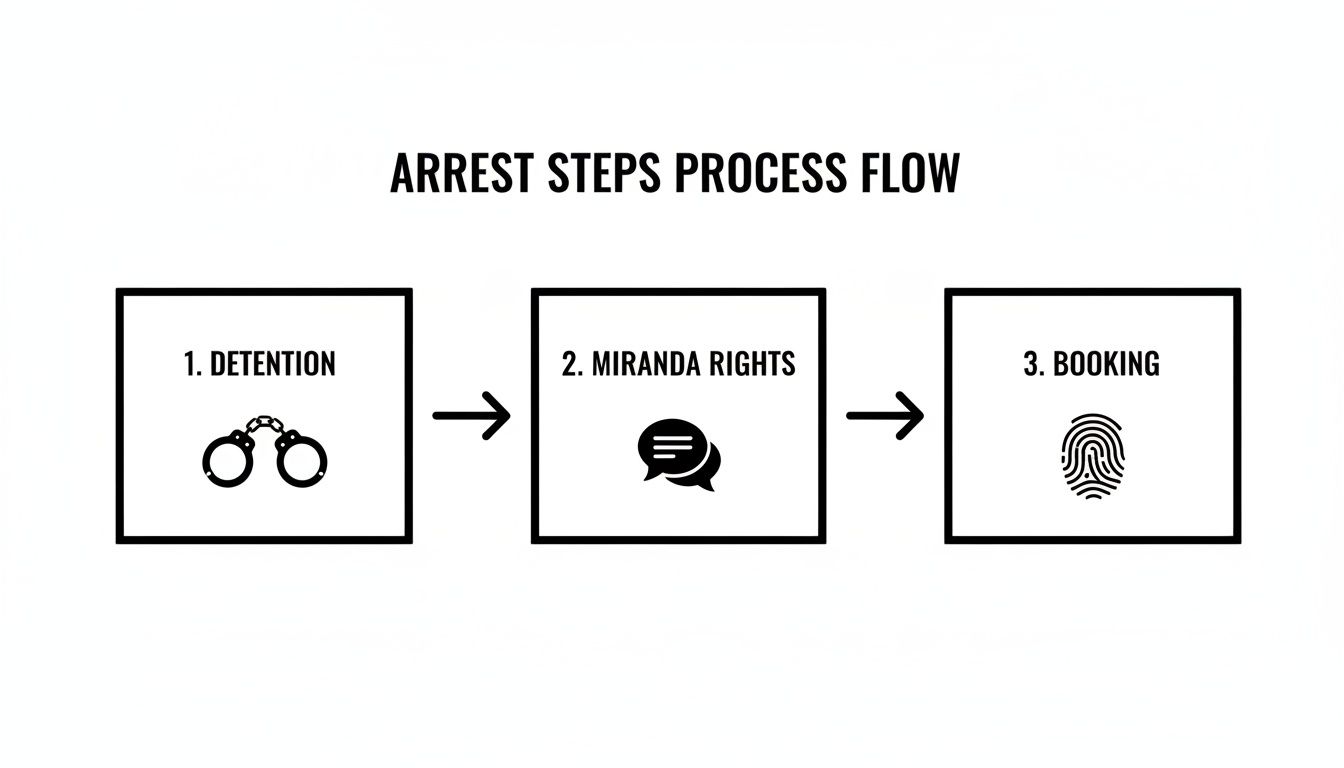
As you can see, the process moves quickly from the initial detention to the booking phase, where your identity is officially recorded by law enforcement.
To give you a clearer picture, here is a quick overview of what to expect immediately following an arrest in our area.
The Arrest Process in Harris County At a Glance
| Stage of Arrest | What Happens | What You Should Do |
|---|---|---|
| Initial Detention | An officer places you in custody, meaning you are not free to leave. | Remain calm. Do not resist, but do not volunteer information. |
| Miranda Rights | You will be informed of your right to remain silent and your right to an attorney. | Listen carefully. State clearly, "I am exercising my right to remain silent." |
| Transport & Booking | You are taken to a police station or jail for fingerprinting, photos, and paperwork. | Cooperate with the basic booking procedures, but do not answer any questions about the case. |
This table lays out the fundamental sequence of events, but remember that the best action is always to say as little as possible until you've spoken with legal counsel.
The Immediate Steps After an Arrest
For anyone living in Humble, Atascocita, or the surrounding Northeast Houston area, the arrest process generally follows a predictable sequence. Knowing what these steps are can help dial down the anxiety and, more importantly, empower you to protect your rights from the get-go.
Initial Detention and Custody: This is the moment a law enforcement officer officially places you under arrest. The key here is that you are no longer free to leave. It's a significant step up from a simple detention, like being temporarily pulled over for speeding.
Miranda Rights: The officer is required by law to read you your Miranda Rights. These are not just lines from a TV show; they are your fundamental constitutional protections, including the right to remain silent and the right to an attorney. It is absolutely crucial that you remember and exercise these rights.
Transport and Booking: From the scene, you will be transported to a police station or a Harris County jail facility for booking. This is purely an administrative procedure—it is not a trial or a determination of guilt.
An arrest is the beginning of a legal process, not the final word. The actions you take in these first few hours are critical for setting the foundation for a strong defense. Protecting your rights starts now.
To get a better sense of what comes next, you can learn more about what happens after an arrest, including more detail on the booking and potential release process. The journey through the legal system is complex, but you don't have to face it alone. The Law Office of Bryan Fagan is here to stand with our Humble neighbors. If you or a loved one has been arrested, call us for a free, confidential consultation.
The Anatomy of an Arrest in Harris County

To really wrap your head around what happens when you're arrested, you first need to understand the rulebook police in Humble have to follow. An arrest isn't a random event; it's the end result of a process with strict legal benchmarks. Every step, from the moment an officer flashes their lights to the point they put you in handcuffs, is governed by these rules.
First off, an officer can't just stop you on a whim. To pull over your car or stop you on a Kingwood street, they need what's called reasonable suspicion. This isn't just a gut feeling. It means the officer must be able to point to specific, observable facts suggesting that you've been involved in a crime, are in the middle of one, or are about to commit one.
From Reasonable Suspicion to Probable Cause
Getting from a temporary stop to a full-blown arrest requires a much higher standard of proof: probable cause. This is a significant legal leap. It means the officer has gathered enough solid facts and circumstances to make a reasonable person believe a crime definitely happened and that you're the one who committed it.
Think of it this way: reasonable suspicion is seeing smoke in the distance. Probable cause is getting closer and seeing the fire that's causing it.
Here’s how this plays out on the streets of Northeast Houston:
- A DWI Stop: An officer sees a car weaving on Atascocita Road. That's reasonable suspicion to make a traffic stop. If they approach the car and smell alcohol, see glassy eyes, and you then fail a field sobriety test, they've now built up to probable cause for a DWI arrest.
- A Theft Accusation: A shop owner in Humble reports a theft and gives a description that matches you. That might be enough for an officer to stop you (reasonable suspicion). If, during a legal search, they find the stolen items in your bag, that elevates it to probable cause.
Grasping this difference is absolutely vital. Why? Because an arrest that lacks probable cause is illegal, and any evidence gathered from it can be thrown out in court. This could lead to your entire case being dismissed.
What Police Can and Cannot Do
During any encounter with law enforcement, your knowledge of your rights is your strongest shield. Officers have certain authorities, but those powers have very clear boundaries.
What an Officer Can Legally Do:
- Ask for Your ID: In Texas, you are generally required to identify yourself when asked by a police officer.
- Conduct a Pat-Down: If an officer reasonably believes you are armed and could be a danger, they can perform a limited search of your outer clothing for weapons. This is often called a "Terry frisk."
- Question You: They are free to ask you questions about your whereabouts, what you're doing, and other details.
Crucial Takeaway: You have the right to remain silent. You are not obligated to answer questions about where you've been, what you've been doing, or anything else that could incriminate you. The best response is to calmly and clearly say, "Officer, I am exercising my right to remain silent."
What an officer cannot do without a warrant or very specific exceptions is search your personal property. To search your car, for instance, they typically need your permission, a warrant, or probable cause to believe there's evidence of a crime inside the vehicle (this is known as the "automobile exception"). You always have the right to say no to a search.
The most critical advice we give to our neighbors in the Humble community is this: stay calm and be polite, but firmly and respectfully assert your rights. Don't argue, never resist, and absolutely do not run. Simply state that you are remaining silent and that you want an attorney. This is the surest way to protect your rights without making a bad situation worse.
If you find yourself in this position, knowing these rules is the first step. The very next step should be calling an experienced criminal defense attorney who will fight to protect you. Schedule a free consultation with our Humble office today to see how we can help.
Understanding Your Constitutional Rights
When you're put in handcuffs in Humble, a set of powerful, invisible protections kicks in. These are your constitutional rights. We’ve all heard the Miranda Rights read on TV shows, but they aren't just dialogue for a police drama—they are your first, and arguably most important, line of defense against the full weight of the government.
The two absolute cornerstones of this protection are the right to remain silent and the right to an attorney. Grasping what these really mean in the heat of the moment can completely change the outcome of your case. Imagine it this way: the second you're arrested, the police and prosecutors start constructing a case against you. Every question they ask is designed to find another brick to build that case, and your own words are often the strongest material they can get their hands on.
It's a deeply human response to want to defend yourself, to explain your side of things. You might be thinking, "If they just hear what really happened, this will all be cleared up." As a local attorney who has helped countless Humble families, I can tell you from experience, that's rarely how it works. This is one of the most critical mistakes you can make. Even a statement you think is harmless can be twisted, used out of context, and turned into a weapon against you in a Harris County courtroom.
The Power of Silence
Let me be clear: choosing to remain silent is not an admission of guilt. It's a smart, calculated move. Police officers are trained in interrogation methods designed specifically to get you to talk. Your only job at that moment is to politely but firmly say, "I am exercising my right to remain silent, and I want to speak with an attorney."
Once you invoke those rights, the questioning is supposed to end. You’ve effectively put up a wall, stopping law enforcement from gathering any more verbal evidence from you. Remember, anything you say before you invoke this right can—and probably will—be used to help the prosecution.
Using Your Phone Call Wisely
After an arrest, you'll typically get a phone call. This is a crucial moment. The natural urge is to call a loved one to tell them what’s going on, and that’s understandable. But your most strategic call should be to a seasoned criminal defense lawyer.
For anyone arrested in Humble, Atascocita, or Kingwood, here's a practical, step-by-step way to handle it:
- Call a Trusted Family Member or Friend: Keep it brief. Tell them you've been arrested and where you are. Ask them to start searching for a local criminal defense attorney right away.
- Call a Criminal Defense Attorney: This is the top priority. A lawyer can immediately advise you on what to do (and what not to do) and start working on your behalf.
This is when you hand the reins to a professional who can navigate the system for you. An arrest is overwhelming, especially when you think about the sheer size of the justice system. For instance, getting arrested for assault in Kingwood means you're being pulled into a system where U.S. prisons hold roughly 1.8 million people as of 2025, and Texas is a major part of that statistic. You can read more about incarceration statistics and their implications to get a better sense of what you're up against.
The most powerful tool you have immediately after an arrest is your silence. The second most powerful tool is the voice of an experienced attorney speaking on your behalf. Don't give up either one.
By refusing to answer questions and immediately calling for legal help, you aren't getting in the way of justice—you're protecting your own. You're making sure your side of the story is told correctly, at the right time, and by a professional who understands the law and the local Harris County courts.
If you or someone you care about has been arrested, don't wait. Contact The Law Office of Bryan Fagan for a free, confidential consultation. Let our Humble-based team be your shield and your advocate.
The Booking and Bail Process Explained

After the blur and shock of an arrest, you'll be transported to a Harris County jail facility. This is where booking begins—the cold, administrative process of officially entering you into the criminal justice system. It's designed to be impersonal, but knowing what to expect can give you a small sense of control.
During booking, officers will take down your personal information, like your name and address. They’ll also take your fingerprints and a photograph (the "mugshot"). All of your personal items will be taken, cataloged, and stored until you're released.
This is often the moment when reality truly sinks in. One minute you're dealing with an incident in Atascocita, and the next you feel like a statistic. Considering the U.S. has an incarceration rate of 541 per 100,000 people—one of the highest in the world—that feeling isn't unfounded.
Once you’re at a place like the Harris County jail, you’ll be held until you can see a judge, which by Texas law must happen within 48 hours. For families waiting on the outside, those two days can feel like an eternity.
Securing Your Release Through Bail
With booking out of the way, the focus for you and your family shifts to one critical goal: getting you home. This is where bail comes into play. Bail is essentially a financial promise you make to the court. By posting it, you are allowed to go home while your case proceeds, with the understanding that you will show up for all your required court dates.
In Humble and throughout Harris County, a judge or magistrate is responsible for setting the bail amount. They don't just pick a number out of thin air; they weigh several key factors.
- The Seriousness of the Alleged Crime: A felony charge will almost always carry a much higher bail than a misdemeanor.
- Your Criminal History: If you have prior convictions, the court might see you as a higher risk, which could mean a higher bail.
- Ties to the Community: Do you have a job, a family, and a home in the Humble or Kingwood area? These things show the judge you're less likely to flee.
- Public Safety Concerns: The judge will always consider whether releasing you could pose a danger to the community.
This is one of the first places a good attorney can make a real difference. We can argue on your behalf at a bail hearing, presenting the evidence of your community ties and reliability to push for a lower, more reasonable bond.
Different Types of Bail Bonds in Texas
For most families, figuring out how to pay for a release can be a confusing and stressful ordeal. It helps to know that you have a few different options for posting bail in Texas.
Getting out on bail is about more than just getting home. It allows you to be an active participant in your own defense, work closely with your attorney, and keep life as normal as possible for your family while the case unfolds.
Here are the most common ways to secure a release:
- Personal Recognizance (PR) Bond: This is the best-case scenario. The judge decides to release you based on your written promise to return for court dates, with no money down. PR bonds are usually reserved for minor offenses and given to people with deep community roots and a clean record.
- Cash Bond: This is exactly what it sounds like—you or your family pays the full bail amount directly to the court in cash. The court holds onto the money until your case is over. As long as you make all your appearances, the cash is returned (minus some administrative fees).
- Surety Bond: This is by far the most common path. You work with a bail bondsman, who acts as a guarantor for you. Your family pays the bondsman a non-refundable fee, which is typically 10% of the total bail amount. In return, the bondsman posts the full bail amount with the court, securing your release.
For many families in Northeast Houston, a surety bond is the only realistic way to get a loved one out of jail without draining their savings. If you need help with the practical steps, this guide on how to bail someone out is a great resource. We've also put together our own in-depth guide with local information on how to bail someone out of jail in Texas.
Common Bail Amount Ranges in Harris County
To give you a better idea of what to expect, we've compiled a table of typical bail ranges for common offenses in our area. Keep in mind that these are just estimates; a judge will make the final decision based on the specific facts of your case.
| Offense Type (Example) | Classification | Typical Bail Range |
|---|---|---|
| First-Time DWI | Class B Misdemeanor | $500 – $2,000 |
| Possession of Marijuana (< 2 oz) | Class B Misdemeanor | $500 – $1,500 |
| Theft ($100 – $750) | Class B Misdemeanor | $1,000 – $2,500 |
| Assault with Bodily Injury | Class A Misdemeanor | $1,500 – $5,000 |
| Possession of a Controlled Substance (< 1g) | State Jail Felony | $2,000 – $10,000 |
| Burglary of a Habitation | Second-Degree Felony | $10,000 – $30,000 |
| Aggravated Robbery | First-Degree Felony | $30,000 – $100,000+ |
As you can see, the costs can escalate quickly, especially as you move from misdemeanors to felonies. This is why having strong legal representation from the very beginning is so important.
The booking and bail process is your first, and arguably most important, hurdle in the criminal justice system. If you or a loved one has been arrested, The Law Office of Bryan Fagan is here to help you clear it. Contact our Humble office for a free consultation to talk about your case and find out how we can fight to get you home.
Your First Day in Court: The Arraignment
After you’ve navigated the initial shock of booking and posting bail, your first official trip inside a Harris County courtroom will be for the arraignment. This is a short hearing, but it's a make-or-break moment. It’s where the starting gun for the court process is fired, and what happens here can shape the entire trajectory of your case.
For most folks in Humble, this is the first time they've ever stood in front of a judge. The judge will formally read the charges the prosecutor has filed against you. Then, they’ll ask you a simple, direct question: "How do you plead?"
It's a moment that can feel like the weight of the world is on your shoulders, but the correct answer is almost always the same.
The Importance of Pleading Not Guilty
At your arraignment, pleading "not guilty" is the standard, and frankly, the only smart move. This isn't a lie, and it doesn't mean your case is destined for a dramatic jury trial. Pleading not guilty is a procedural necessity that keeps every single one of your legal options open.
Think of it like this: pleading guilty right away is like slamming a book shut before you've even read the first chapter. When you plead not guilty, you are simply telling the court that the prosecution has to do its job and prove its case. This gives your attorney the crucial time needed to dig into the evidence, identify weaknesses, and build a defense strategy.
Entering a "not guilty" plea isn't a statement about what happened; it's an assertion of your constitutional right to a fair legal process and the presumption of innocence.
By taking this step, you protect your ability to negotiate for a better outcome, file motions to throw out illegally gathered evidence, or prepare for trial if it comes to that. It’s the move that gives you leverage.
Key Players in the Courtroom
Walking into a courtroom for the first time is understandably intimidating. Knowing who’s who and what their role is can help take some of the mystery out of it. During your arraignment in a Northeast Houston court, you’ll see three main people in charge:
- The Judge: The judge is the referee. They run the hearing, make sure everyone follows the rules, and make important decisions. They’ll read the charges, take your plea, and set the conditions for your release, including bail.
- The Prosecutor: This is the lawyer for the state of Texas. Their entire job is to prove the case against you. At the arraignment, they are the one who formally presents the charges to the court.
- Your Defense Attorney: This is your champion, your advocate, and your voice. Having a lawyer from The Law Office of Bryan Fagan standing next to you is critical. We will stand with you, enter the "not guilty" plea for you, and start protecting your interests on the spot.
The arraignment is also our first real chance to challenge the conditions of your release. We can argue for a lower bail amount or push back against restrictive bond conditions, like a GPS monitor or constant check-ins. Taking these actions right away can have a huge impact on your freedom and your ability to work on your defense from home instead of a jail cell. To get a deeper look into this initial court appearance, you can learn more about what happens at an arraignment hearing in our detailed guide.
Your arraignment is where the legal fight truly begins. If you or someone you care about is facing this first court date, you don't have to face it alone. Call our Humble office for a free consultation. Let us stand by your side and make sure your rights are protected from day one.
How a Humble Criminal Defense Attorney Protects You

Trying to navigate the criminal justice system by yourself is a lot like trying to find your way through a maze blindfolded. Every turn looks the same, the rules are confusing, and a single wrong step can lead to serious, life-altering consequences. Think of a dedicated local attorney from The Law Office of Bryan Fagan as your guide—someone who knows the layout of that maze and can lead you toward the best possible exit.
From a traffic stop on a quiet Kingwood street to a formal arraignment in a Harris County court, we become your shield and your advocate. We get the fear and uncertainty your family is going through because we're part of this community, too. Our job is to give you a clear, confident path forward so you can start to get some control back over your life.
Protecting Your Rights at Every Stage
A good attorney does a lot more than just show up for court dates. We start working on your behalf the second you call us, stepping in at critical moments all along the way.
Here’s a look at how we protect our neighbors in Humble and Atascocita:
- During Questioning: We make sure the police respect your right to remain silent, stopping you from accidentally making statements that could be twisted and used against you.
- At the Bail Hearing: We argue for your release on fair and reasonable terms. By presenting evidence of your ties to the community—like your job and family—we fight for the lowest possible bond.
- Analyzing the Evidence: We dig into everything. Police reports, witness statements, and every piece of evidence are meticulously reviewed to find cracks and weaknesses in the prosecution's case.
- Challenging Illegal Actions: If your rights were violated, such as through an illegal search of your car or home, we file motions to get that evidence thrown out. Sometimes, this is enough to get the entire case dismissed.
This proactive approach isn't just about legal tactics; it's about leveling the playing field. The state has enormous resources, but with us in your corner, you have a powerful defender fighting for you.
The most critical decision you make after an arrest isn't what you say to the police, but who you choose to speak for you. An experienced attorney is your voice when you need it most.
A Local Advocate Who Understands the System
The legal system isn’t just about what the law books say; it’s about how those laws are actually applied in our local courts. We know the Harris County prosecutors and judges. That familiarity helps us anticipate their strategies and negotiate more effectively for you, whether we're pushing for a charge reduction, a favorable plea agreement, or gearing up to present a compelling case at trial.
We genuinely believe that every Humble resident deserves a robust defense. We take the time to listen to your side of the story, answer your questions in plain English, and build a defense strategy that fits the unique facts of your situation. You can get a better sense of our philosophy by reading our guide on how to choose a criminal defense lawyer.
Your future is simply too important to leave to chance. If you or someone you love is facing the terrifying aftermath of an arrest, your very next step should be a simple phone call. Contact The Law Office of Bryan Fagan for a free, completely confidential consultation. Let us show you the way forward.
Common Questions After an Arrest in Texas
When you're facing the legal system, everything can feel uncertain and overwhelming. For our clients here in Humble, Atascocita, and across Northeast Houston, we've found that getting straightforward answers is the first step toward regaining a sense of control. These are a few of the most frequent questions we get from people right after an arrest.
How Long Can Police Hold Me Before I See a Judge?
Texas law is pretty specific here: law enforcement can't just leave you sitting in a cell indefinitely. They are required to bring you before a magistrate for your initial appearance, known as an arraignment, without "unnecessary delay." In practice, this almost always means you'll see a judge within 48 hours of being arrested.
This initial two-day period is absolutely crucial. Having a lawyer on your side from the very beginning can make all the difference, as we can immediately start arguing for your release and pushing for reasonable bail conditions.
What’s the Difference Between Being Detained and Arrested?
This is a really important distinction, and it directly impacts your rights. Think of detention as a temporary stop. An officer has "reasonable suspicion" to pull you over or question you. You aren't free to just walk away, but you aren't officially under arrest either.
An arrest, however, is far more serious. This happens when an officer believes they have "probable cause"—a higher legal standard—that you've committed a crime, and they take you into custody. While your constitutional rights kick in during both situations, an arrest is the formal start of a criminal case against you.
It's vital to know whether you're just being stopped or formally arrested. Either way, the best thing you can do is stay calm, say as little as possible, and immediately ask for your lawyer.
Will an Arrest Show Up on My Record If the Charges Are Dropped?
Yes, and this is a harsh reality that catches many people by surprise. The arrest record itself doesn't automatically disappear if the charges are dismissed or if you're found not guilty. It can linger on background checks for years, creating problems when you're applying for a job, an apartment, or even a loan.
The good news is that you don't have to be stuck with it. A skilled attorney can guide you through a legal process called an expunction or an order of non-disclosure. These are powerful legal tools we use for our Humble-area clients to permanently clear an arrest from their record, allowing them to truly move forward with their lives.
Should I Talk to the Police If I Know I’m Innocent?
Absolutely not. This might be the single most critical piece of advice anyone can receive. Even if you are 100% innocent, you should always invoke your right to remain silent until you've spoken with a lawyer. It is incredibly easy for innocent comments to be twisted, misunderstood, or remembered incorrectly by an officer writing a report.
Your best and safest response is to state clearly and politely, "I am exercising my right to remain silent and I would like to speak to my lawyer." This simple sentence protects you completely and puts your attorney in control of all future communication.
An arrest can throw your entire life into chaos, but you don't have to go through it by yourself. At The Law Office of Bryan Fagan, we are committed to protecting the rights of our neighbors in Humble, Kingwood, and all over Northeast Houston. We give you the clear guidance and aggressive defense you deserve. Let's talk about your case—schedule your free, no-obligation consultation with our Humble office today by calling (281) 810-9760 or visiting us online at https://humbletxlawyers.com.