Skip to content

Your phone stays silent. The exchange time passes. Then a text comes in, or maybe nothing comes at all. If you're in Humble, Atascocita, Kingwood, or elsewhere in Northeast Houston, that moment can turn your whole evening upside down. You're worried about your child, angry at your ex, and unsure whether you should call the police, send a harsh reply, or drive across town.
Slow down. Your next move matters.
When parents search for what to do if an ex violates a custody order in Humble, Texas, the question is usually more immediate: what should I do tonight, and what should I do tomorrow morning so I don't make this worse? In most cases, the strongest response is calm, organized, and documented. Courts work from facts, not frustration. If you handle the first hours well, you put yourself in a much better position if the problem continues and Harris County court involvement becomes necessary.
Your First Response When a Custody Violation Occurs
The first violation often feels personal. The law, however, treats it as a problem of proof.
If your ex misses an exchange, returns the child late, refuses to release the child, or starts changing the schedule without agreement, your first job is to preserve evidence. Family-law guidance consistently recommends a contemporaneous log, preserved texts and emails, and careful notes before escalating, because written records create the factual foundation for enforcement and help you avoid self-help that can become a separate violation of the order, as explained in this guidance on responding to custody-agreement violations.
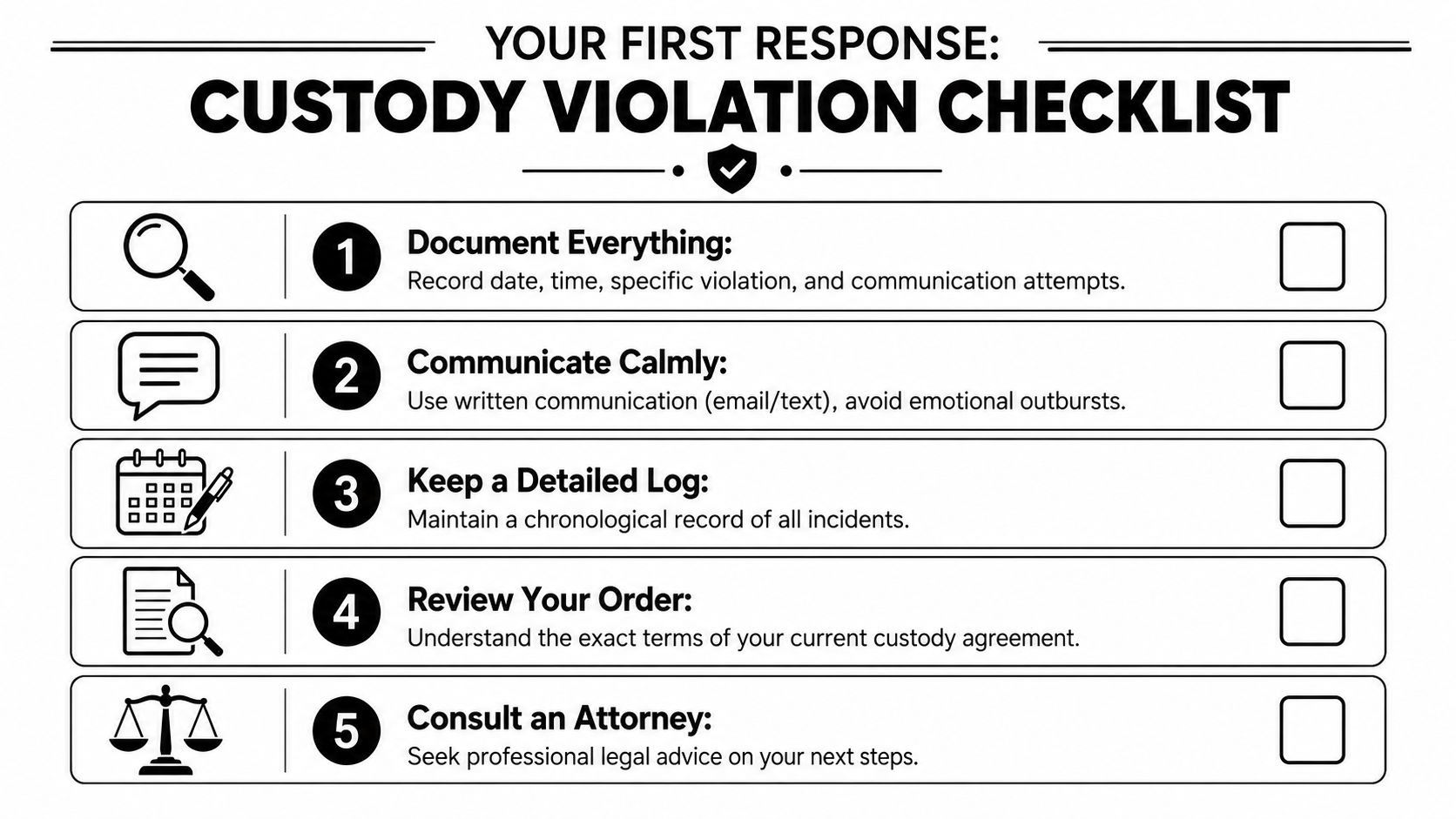
What to record right away
Write down the facts while they're fresh. Don't rely on memory tomorrow.
- Exact time: Note when the exchange was supposed to happen and when you arrived.
- Exact location: Use the address or the named exchange location in your order.
- What happened: Missed exchange, late drop-off, refusal to answer, last-minute cancellation, or a statement that the child wouldn't be returned.
- Your efforts to comply: Record that you were present, on time, and ready.
- Communication attempts: Save screenshots of texts, call logs, emails, and app messages.
- Witnesses or supporting proof: If someone was with you, note that. Keep receipts, parking records, or photos if they help show you were there.
Practical rule: Write like a judge may read it later. Stick to who, what, when, and where.
A strong entry in your log is simple: date, time, place, order language, your arrival, your communication, and the result. A weak entry is emotional and vague, like "he always does this."
What not to do tonight
Parents sometimes damage a strong case by reacting in the heat of the moment.
Don't threaten. Don't unload in a long text thread. Don't decide you'll "get even" by withholding the child the next time it's your turn. That kind of retaliation can create a fresh problem for you.
Use short written communication instead. Something like this works better: "I am at the exchange location listed in the order. It is [time]. Please confirm when you will arrive." If the other parent refuses the exchange, keep your reply brief and save it.
For a practical guide on creating records the court can use, review this page on how to document custody violations in Texas.
Your mindset matters
Tonight is not the night to prove a point. It's the night to build a record.
That record should show that you followed the order, stayed calm, and gave the other parent every chance to comply. In Humble-area custody disputes, that difference matters. Parents who document carefully often look more credible than parents who argue loudly but preserve nothing.
Deciding When to Involve Law Enforcement in Humble
It is 7:00 p.m. in the parking lot, your child is not being returned, and the other parent has stopped answering. At that moment, the question is not whether the behavior is unfair. The question is whether you have a safety problem or an enforcement problem.
In Humble custody cases, that distinction matters. Police can respond to immediate danger, threats, violence, intoxication, or a real risk that a parent is about to leave with the child in violation of the order. Police usually do not force a routine possession exchange just because one parent is late, evasive, or refusing to cooperate.
When calling law enforcement makes sense
Call law enforcement if the facts suggest the child may be at risk right now. Examples include credible threats to take the child out of the area, signs of intoxication during the exchange, family violence, abandonment, or a situation where you do not know where the child is and the other parent has gone silent.
In those moments, stay factual. Have the order with you. Tell the officer the exact provision that applies, what happened, where you are, and why you believe there is an immediate safety concern. Ask for an incident report number if one is created.
Texas legal guidance from Texas Law Help's page on visitation and possession orders explains the practical limits of police involvement in family court matters. For a local explanation of whether police can enforce a custody order in Texas in Humble, review how officers typically treat civil possession disputes versus emergencies.
When police usually will not solve the problem
A single missed exchange, a late pickup, or a parent who claims they are "running behind" is usually a court enforcement issue. So is a last-minute refusal that does not involve danger.
That does not mean the violation is minor. It means the remedy usually comes from Harris County family court, not from an officer at the scene.
| Situation | Likely response |
|---|---|
| Parent is late to pickup | Officer may document it, but often will not force the exchange |
| Parent refuses one exchange without safety concerns | Usually treated as a civil custody dispute |
| Parent is hostile by text but the child appears safe | Better handled through documentation and a court filing |
| Parent appears intoxicated or threatens to disappear with the child | Police involvement is often appropriate |
The practical rule for tonight
Use law enforcement to address danger, not to pressure the other parent in an ordinary dispute.
Parents hurt their own position when they call police over every disagreement, argue with officers, or turn a tense exchange into a scene. Judges notice patterns. A parent who stays calm, states the facts, and calls police only when the facts justify it usually appears far more credible than a parent who treats every violation like an emergency.
If you are on the fence, ask yourself two questions: Is my child unsafe right now? Is there a real chance the child will be hidden, removed, or exposed to immediate harm? If the answer is no, preserve the evidence and prepare to enforce the order in court.
Filing a Motion in Harris County Family Court
Once you've documented a pattern, the court becomes the place to fix it.
In Texas, an enforcement filing has to be precise. Under Texas Family Code Section 157.002, the motion must identify the exact provision being enforced, describe how the other parent failed to comply, and request a specific remedy. Texas Law Help also explains that you must state the date, place, and, if applicable, time of each missed exchange and attach evidence showing a pattern of denials. That's why a vague complaint usually isn't enough for parents in Humble or Northeast Houston. The details matter, as explained in Texas Law Help's overview of enforcing a visitation order.
The three filings parents usually ask about
Most parents use one of these paths, depending on the facts.
| Motion Type | Primary Goal | When to Use It |
|---|---|---|
| Motion to Enforce | Ask the court to require compliance with the current order | Repeated violations of clear possession or access terms |
| Motion for Contempt | Ask the court to treat willful disobedience as contempt | When violations are repeated, clear, and supported by strong proof |
| Emergency request such as temporary restraining relief | Ask the court for immediate protective intervention | When there is urgency involving safety or removal risk |
Motion to Enforce
This is the main tool when the order is already clear and the other parent isn't following it. You're not asking the judge to create a new parenting plan. You're asking the judge to enforce the one already signed.
That means your paperwork should line up each violation with the exact language in the order. If the order says pickup occurs at a certain time and place, the motion should match that wording to the missed event.
Contempt issues
Contempt is more serious. It tells the court that the violation wasn't just inconvenient. It was a knowing failure to obey a court order.
Because contempt can carry significant consequences, courts expect clean, specific proof. Sloppy records and generalized complaints usually don't hold up well here.
The court can't enforce what you can't describe clearly. Dates, places, and the exact broken term are the backbone of the case.
Emergency requests
Emergency relief is not for every custody conflict. It is for situations where waiting creates real risk. If the concern is immediate danger or removal, a lawyer can help you evaluate whether emergency action fits the facts.
Parents in Harris County sometimes assume every ugly co-parenting dispute should be filed as an emergency. Usually, that's not the most effective strategy. Judges want the filing that matches the problem.
What to Expect from the Court Process and Potential Remedies
Once a motion is filed, many parents feel relief mixed with anxiety. That's normal. Court action creates structure, but it also takes patience.
A typical enforcement matter often starts with preparing the evidence, filing the motion, and making sure the other parent is properly served. Then the court sets a hearing. Some cases settle before the hearing once the violating parent realizes the issue is now in front of a judge. Others proceed to testimony, documents, and a ruling.
Early in that process, it helps to see the road ahead.
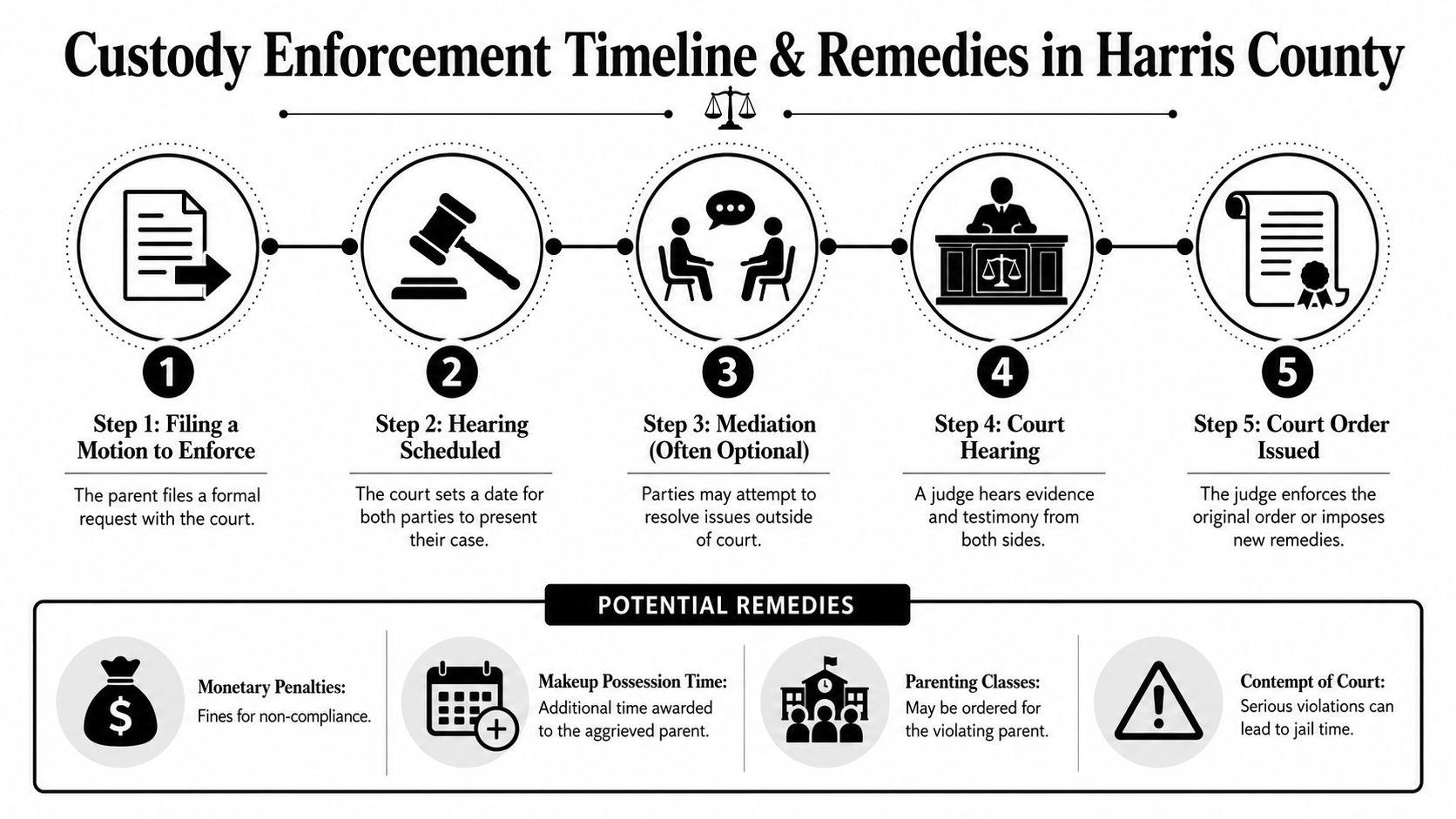
A realistic hearing picture
At the hearing, the judge usually wants to know a few things quickly:
- Was there a valid order
- Was the order clear enough to enforce
- Did the violation happen as alleged
- Can the moving parent prove it with reliable evidence
That brings the focus back to your records. Judges tend to respond better to a clean timeline than to a broad story about years of conflict.
After you review the visual overview below, the next step is understanding the possible outcomes in practical terms.
Remedies that can change the situation
Courts take custody-order violations seriously because they have meaningful enforcement tools, including contempt findings, fines, make-up parenting time, and even jail in some jurisdictions. Women's Law states that a judge who finds a parenting-time violation can impose a fine of up to $100 per incident and may also schedule modification proceedings, as noted in this explanation of what a parent can do when the other parent violates a custody order.
In real life, that can mean:
- Makeup time: The court may award time to replace what you lost.
- Orders to comply going forward: Judges can issue directives that remove ambiguity and make future violations harder to excuse.
- Financial consequences: Courts may use fines or other monetary remedies where appropriate.
- Contempt consequences: In serious cases, the court can treat the conduct as contempt.
A well-prepared enforcement case doesn't just punish past conduct. It can stabilize the next several months of your child's schedule.
For many Humble and Northeast Houston families, the biggest relief is simple. A judge puts structure back where chaos had taken over.
Enforcement vs Modification When Violations Persist
After two or three violations, many parents ask the wrong question. They focus only on how to force one missed exchange or one late return, when the better question is whether the current order still works in real life.
Some cases call for enforcement. Others point to a schedule that has broken down.
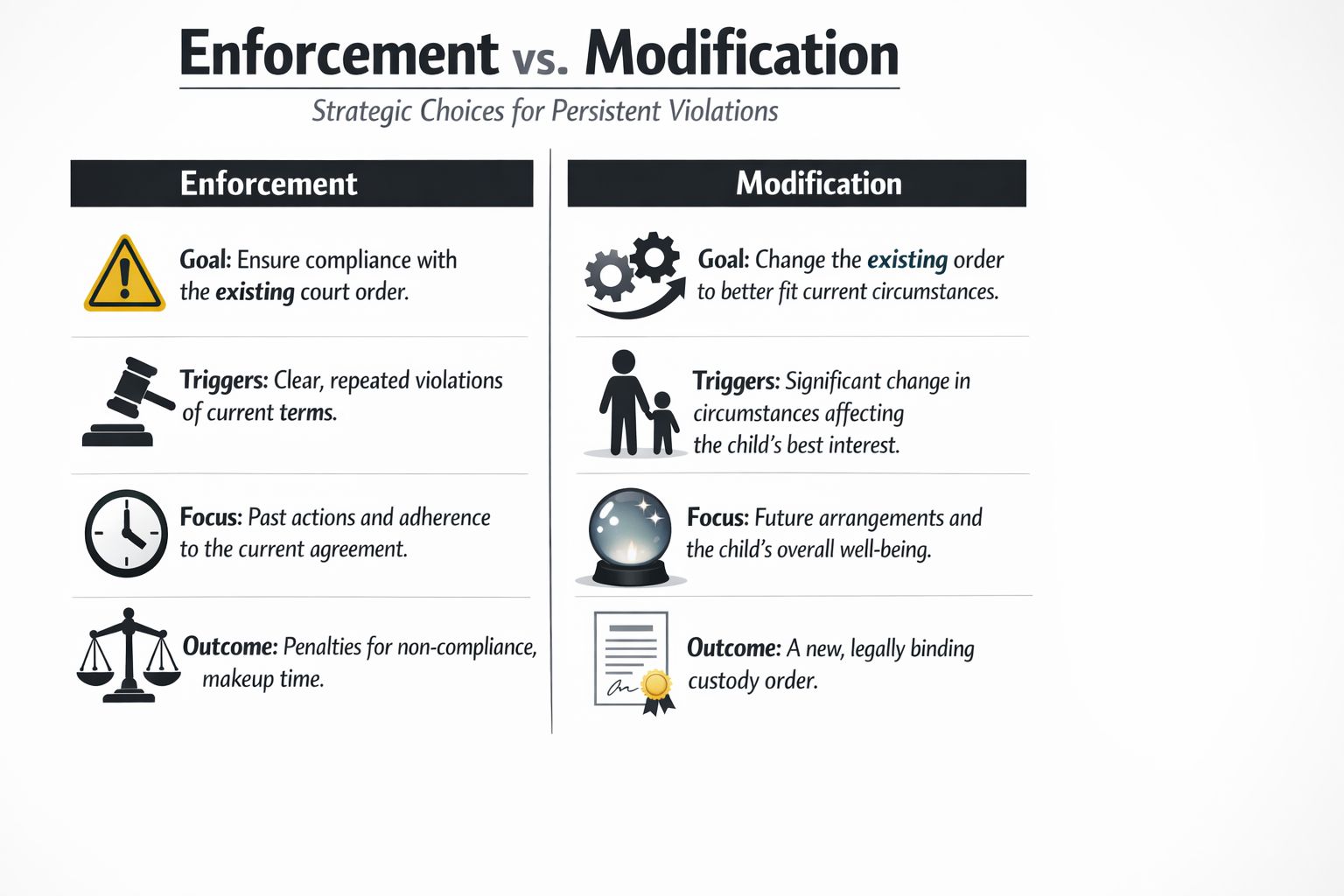
When enforcement is the better fit
Enforcement usually makes sense when your order is clear, the schedule is still practical, and the other parent is choosing not to follow it.
That often includes repeated denials of possession, chronic late exchanges, refusal to return the child on time, or ignoring holiday and weekend terms that are easy to understand. In that situation, the problem is not the paperwork. The problem is noncompliance.
A parent in Humble should stay disciplined here. Keep documenting the exact date, time, location, and what happened. Save the texts. Save the call log. Keep notes short and factual. If the order still fits the family's routine, a clean record of repeated violations usually supports enforcement better than a long argument about fairness.
When modification may solve the real problem
Modification is often the better path when the violations keep happening because the current schedule no longer matches the child's life or the parents' actual circumstances.
Common examples include:
- Changed work schedules: A parent can no longer make the ordered pickup or drop-off times.
- Longer travel or relocation issues: The exchange plan now causes constant conflict or missed school obligations.
- School and activity changes: The child has outgrown the routine in the current order.
- Recurring instability: The same dispute keeps resurfacing even when both parents are trying to make the schedule work.
That distinction matters. If you file for enforcement when the actual issue is an outdated order, you can spend time and money fighting over symptoms instead of fixing the structure. If you are seeing that pattern, review how custody modification in Humble, Texas works before deciding what to file.
Good records still matter in a modification case. They show whether the problem is occasional defiance or a schedule that keeps failing under ordinary family demands. Tools that help parents organize co-parenting schedules can make that pattern easier to spot and easier to present clearly.
Ask what solves the next six months
Parents under stress often want the judge to address what already happened. That is understandable. In court, though, the stronger question is often what order will reduce conflict for your child from now on.
Enforcement looks at violations of a clear order. Modification looks at whether a different order would serve the child better. When violations persist, the right strategy is the one that does both jobs correctly. It holds the other parent accountable when the order is being ignored, and it asks for change when the existing terms no longer hold the family together.
Partner with a Humble Attorney Who Protects Your Family
By the time many parents call a lawyer, the violation itself is only part of the problem. They are exhausted, second-guessing every text, and worried that one angry response could hurt them in court. That is why the right legal help is not just about filing paperwork. It is about getting control of the situation quickly and making smart choices tonight, tomorrow, and over the next few weeks.
A Humble-area family law attorney should start by narrowing the issue fast. Is the order clear enough to enforce as written? Are your records organized well enough to prove specific violations? Is this becoming a safety issue? Or has the conflict reached the point where the current order no longer works in real life, even if both parents keep blaming each other?
Those are different problems. They call for different court requests.
A lawyer who regularly handles family cases in Harris County can review the exact language of your order, match it against what transpired, and help you avoid common mistakes that weaken a case. Parents often hurt their position by arguing too much over text, making side deals outside the order, withholding the child in response, or showing up in court with a stack of screenshots but no clear timeline. Good counsel fixes that before the filing starts.
For families in Humble, Atascocita, Kingwood, and Northeast Houston, one practical option is to work with the Law Office of Bryan Fagan's Humble office to review the order, sort the evidence, and decide whether enforcement, contempt-related relief, or modification fits the facts.

Protect your credibility as much as your rights
In custody enforcement cases, credibility matters. Judges pay close attention to which parent stayed child-focused, followed the existing order when possible, and kept records without escalating the conflict.
That work starts before anyone walks into court. Save messages. Keep exchange notes. Write down dates, times, locations, and who was present. Stick to calm communication. If you are upset, wait before responding. A short, neutral message usually helps more than a long argument.
An attorney's job is to turn that discipline into a legal strategy the court can use. That may mean preparing a clean violation chart, identifying which missed exchanges are enforceable, deciding whether to ask for makeup time, fees, contempt findings, or a larger change to the parenting plan.
Good family-law advocacy reduces chaos. It gives the court a clear record, a focused request, and a practical path to protect your child and your parenting time.
You do not need to have every answer before you ask for help. You need enough clarity to avoid the mistakes that make a bad situation harder.